








In today’s hyper‑connected digital world, organizations across India—from banks and e‑commerce platforms to government agencies and startups—are constantly facing cyber threats. This has led to a massive surge in demand for skilled cybersecurity professionals and, in turn, the rise of top‑quality cyber security certification courses in India. Choosing the right certification, however, can be confusing for beginners, freshers, and even working IT professionals. In this article, we’ll break down what makes a best cyber security certification course in India, who should enroll, and what to look for in 2026.
Why Cybersecurity Certification is Important
A cybersecurity certification is no longer just a “nice‑to‑have”; it has become a career necessity in India’s IT and digital ecosystem. Employers prefer candidates who have formal training in network security, ethical hacking, incident response, and risk management. A recognized certification signals that you understand standard frameworks, tools, and best practices used in real‑world environments.
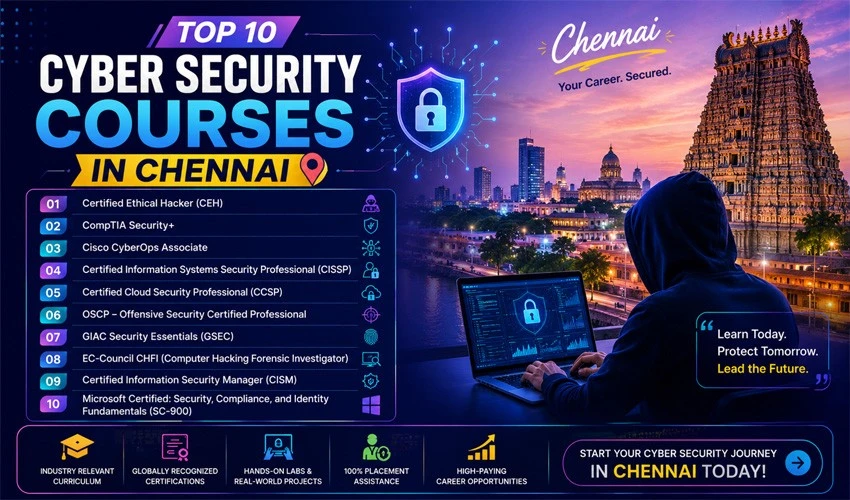
Certifications like Certified Ethical Hacker (CEH), CompTIA Security+, CISSP, and CISM are widely respected in India and globally. These credentials help you qualify for roles such as cybersecurity analyst, SOC analyst, penetration tester, security consultant, and even CISO‑level positions after experience.
What Makes the “Best” Cyber Security Certification Course?
When students and professionals search for the “best cyber security certification course in India,” they are usually looking for a mix of the following factors:
- Reputed institution or brand: Courses tied to universities (like IITs), government bodies (such as NIELIT), or global organizations (like EC‑Council, CompTIA, Google) carry higher credibility.
- Industry‑relevant syllabus: The curriculum should cover modern topics like network security, cloud security, ethical hacking, malware analysis, incident response, and AI‑driven threat detection.
- Hands‑on labs and projects: Practical labs, penetration testing exercises, and capstone projects are essential to build real skills instead of just theory.
- Certification clarity: The course should clearly mention whether it prepares you for a globally recognized exam (e.g., CEH, CompTIA Security+, CISSP) or offers its own industry‑recognized certificate.
- Placement support and job readiness: Many institutes now offer mock interviews, resume workshops, and placement assistance or internships, which are crucial for freshers in India.
- Flexible delivery mode: Online live classes, weekend batches, and recorded lectures help working professionals and college students manage their schedules.
Popular Cyber Security Certification Paths in India
Several certification tracks dominate the Indian market in 2026. Here are some of the most in‑demand options:
- Certified Ethical Hacker (CEH) – EC‑Council: CEH is one of the most popular certifications for ethical hacking and penetration testing. In India, many institutes partner with EC‑Council to offer CEH training, including hands‑on labs with tools like Kali Linux, Metasploit, and Wireshark.
- CompTIA Security+: This entry‑level certification is ideal for beginners who want to build a strong foundation in network security, threat management, and identity access. Many Indian training centers now offer Security+‑focused courses with exam‑oriented preparation.
- CISSP and CISM: These are advanced, management‑oriented certifications for professionals with 3–5 years of experience. CISSP is widely used in India by security managers, consultants, and auditors.
- Government‑linked programs: Agencies like NIELIT and other government‑backed institutes run certificate courses on cyber security, which are affordable and suitable for college students and young professionals.
- University‑level programs: Institutions like IIT Kanpur offer advanced cybersecurity certification courses that combine academic rigor with live classes, case studies, and industry projects. These are especially attractive for working professionals looking for a mid‑career upskill.
Best Cyber Security Certification Courses in India (Overview)
While there are dozens of “best” cyber security courses in India, the top ones usually stand out in either brand value, syllabus quality, or placement support. For example:
- EC‑Council‑affiliated programs often focus on ethical hacking, SOC operations, and advanced threat intelligence. They follow a global curriculum and are accepted by many IT‑MNCs in India.
- IIT Kanpur’s Advanced Cyber Security Certification targets working professionals with more than 2–3 years of IT experience. It offers around 120+ hours of live interactive classes, hands‑on labs, and campus visits, making it one of the most premium options in India.
- NIELIT and other government‑backed certificate courses are budget‑friendly and suitable for students and entry‑level professionals who want a solid theoretical grounding before moving to higher‑level certifications.
- Online‑focused platforms such as Hacker School, Internshala Trainings, and others run certified cyber security and ethical hacking courses delivered entirely online, with projects and assignments that simulate real‑world scenarios.
Who Should Enroll in a Cyber Security Certification Course?
A cyber security certification course in India is suitable for multiple profiles:
- College students (B.Tech, BCA, MCA, M.Sc, etc.): Those pursuing IT or computer science degrees can use a certification as a value‑add to their resume and improve campus‑placement chances.
- IT professionals (developers, network engineers, system admins): Developers and system administrators can transition into security roles like application security analyst, SOC engineer, or security architect by adding a certification.
- Non‑IT graduates and career switchers: Many institutes now design beginner‑friendly courses that assume no prior security knowledge, making it easier for non‑IT graduates to enter this field.
- Government employees and banking professionals: Cybersecurity knowledge is increasingly important for banking, PSU, and government‑sector employees dealing with digital infrastructure and data protection.
Key Features of a Top‑Quality Cyber Security Course
When evaluating the best cyber security certification course in India, pay attention to these features:
- Curriculum depth: Look for modules on network security, web application security, cryptography, malware analysis, digital forensics, cloud security (AWS/Azure/GCP), and incident response.
- Practical labs and tools: A good course should include virtual labs, penetration testing exercises, and exposure to tools such as Kali Linux, Burp Suite, Wireshark, SIEM tools, and vulnerability scanners.
- Live doubt‑clearing sessions: Live doubt‑clearing or Q&A sessions with instructors help learners resolve queries quickly instead of relying only on pre‑recorded videos.
- Capstone projects or assignments: Real‑world projects (such as building a SOC lab, performing a penetration test on a test environment, or analyzing a malware sample) greatly improve job readiness.
- Certification and exam support: Check whether the course covers exam patterns, sample questions, and if it provides voucher discounts or exam‑fee assistance.
- Placement and internship support: Some institutes partner with IT companies, startups, or cybersecurity firms to offer internships, live projects, and campus placements. This is especially valuable for freshers.
How to Choose the Right Course for You
With so many options, selecting the best cyber security certification course in India depends on your:
Current experience level:
- Beginners: Pick entry‑level or foundation courses like CompTIA Security+ or beginner‑oriented cyber security programs.
- Intermediate professionals: Go for ethical hacking, SOC, or network security‑focused certifications such as CEH or vendor‑specific courses.
- Advanced professionals: Aim for management‑level certifications like CISSP or CISM after gaining a few years of experience.
Career goals:
- If you want to become an ethical hacker or penetration tester, choose CEH or similar hands‑on programs.
- If you aspire to be a security manager or consultant, certifications like CISSP or CISM are more suitable.
- If you want to join a SOC or blue‑team environment, focus on SOC analyst–oriented courses and SIEM tools.
Budget and time:
- Government‑backed or short‑term certificate courses (e.g., NIELIT) are usually more affordable.
- University‑level or premium programs (like IIT Kanpur’s course) come with higher fees but offer better brand value and intensive training.
Future of Cybersecurity Careers in India
India is expected to create hundreds of thousands of cybersecurity jobs over the next few years, driven by digitization, fintech growth, and government initiatives like Digital India and cyber‑crime prevention. Organizations are investing heavily in SOC teams, cloud security, and compliance‑driven audit functions. This makes a cyber security certification one of the most valuable skills to acquire in 2026 and beyond.
By completing the best cyber security certification course in India, you position yourself for roles such as:
- Cybersecurity analyst
- SOC analyst
- Penetration tester
- Security consultant
- Security architect
- Cybersecurity auditor or manager
Conclusion
In 2026, the best cyber security certification course in India is one that combines brand‑reputation, practical training, modern syllabus, and job‑oriented support. Whether you’re a student in Ludhiana, a working professional in Bengaluru, or a government employee in Delhi, choosing the right certification path can significantly boost your career prospects. Focus on globally recognized credentials like CEH, CompTIA Security+, CISSP, or CISM, or on high‑quality programs from institutes like IIT Kanpur, NIELIT, and reputable training academies. With the right course and consistent practice, you can build a strong future in India’s rapidly growing cybersecurity landscape.