








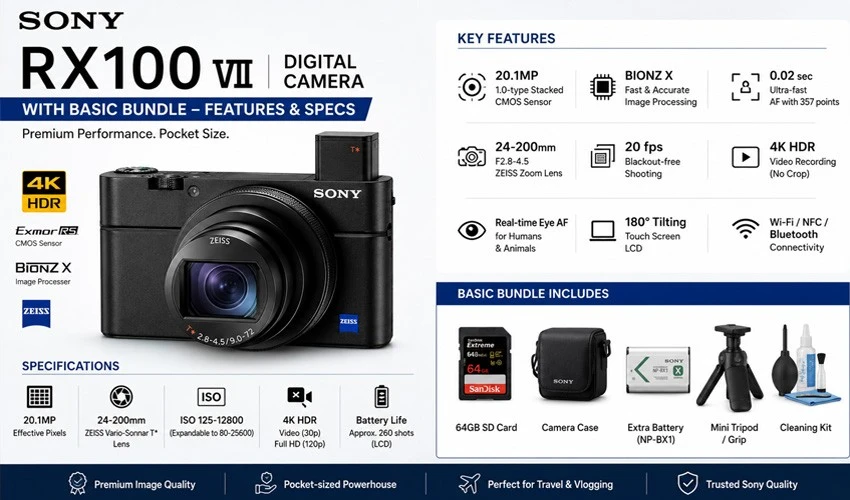
If you’ve ever wished you could carry a professional-grade camera in your jacket pocket, the Sony RX100 VII comes about as close as technology currently allows. Part of Sony’s long-running RX100 series, this seventh-generation compact camera packs autofocus technology borrowed from Sony’s flagship mirrorless cameras into a body small enough to slip into a coat pocket or small purse. When paired with a Basic Bundle — typically including a memory card, spare battery, camera bag, and other everyday accessories — it becomes a genuinely ready-to-shoot kit for photographers, vloggers, and travelers alike.
This article walks through what makes the RX100 VII stand out, what’s typically included in a Basic Bundle, and who this camera is really built for.
A Compact Camera With Big-Camera DNA
The RX100 VII was designed around a simple idea: give enthusiasts and professionals a camera they’ll actually want to carry every day, without asking them to sacrifice image quality or speed. Sony achieved this by placing a stacked 1-inch Exmor RS CMOS sensor — a more advanced version of the sensor found in earlier RX100 models — alongside the latest generation BIONZ X image processor. The combination allows the camera to shoot fast, track subjects reliably, and produce clean images even in less-than-ideal lighting.
Unlike many “point-and-shoot” cameras that stopped evolving years ago, the RX100 VII borrows serious technology from Sony’s a9 series full-frame mirrorless cameras, particularly in the autofocus department. That heritage is immediately apparent once you start shooting moving subjects.
Sensor and Image Quality
At the heart of the RX100 VII sits a 20.1-megapixel 1-inch stacked CMOS sensor. While that resolution figure might look modest compared to some modern smartphones, sensor size matters far more than megapixel count when it comes to image quality. A 1-inch sensor is significantly larger than what you’ll find in a typical smartphone or entry-level point-and-shoot, which translates into better dynamic range, cleaner high-ISO performance, and more pleasing background separation.
The camera supports sensitivity up to ISO 12800, giving it reasonable flexibility in dim environments such as indoor events, evening streets, or restaurants — situations where many compact cameras start to struggle.
The Zeiss 24-200mm Lens
One of the RX100 VII’s headline features is its built-in Zeiss Vario-Sonnar T* 24-200mm equivalent lens, offering roughly 8.3x optical zoom. This is a substantial range for a pocket camera. At the wide end (24mm), you get enough field of view for landscapes, architecture, and group shots. At the telephoto end (200mm), you can comfortably shoot distant subjects, wildlife, or candid street photography without needing to get physically close.
The maximum aperture ranges from f/2.8 at the wide end to f/4.5 at full zoom. That’s respectably fast for a lens covering this much range, though it’s worth noting that at 200mm, low-light shooting becomes more challenging since less light reaches the sensor. For daylight versatility, however, this lens is hard to beat in a camera this size.
Autofocus That Punches Above Its Class
Autofocus is where the RX100 VII truly separates itself from typical compact cameras. It features 357 phase-detection autofocus points combined with 425 contrast-detection points, covering the vast majority of the frame. The system can perform focus and exposure calculations up to 60 times per second, allowing it to track erratic or fast-moving subjects with confidence.
Real-Time Tracking and Real-Time Eye AF are standout additions. These features let the camera lock onto a subject’s eye — whether human or animal — and maintain focus as the subject moves, even if they turn their head or move in and out of the frame. This is especially useful for parents photographing kids, pet owners, or anyone shooting portraits without a dedicated assistant to manage focus manually.
Blazing-Fast Burst Shooting
For action photography, the RX100 VII offers blackout-free continuous shooting at up to 20 frames per second with full AF/AE tracking. Because there’s no viewfinder blackout between shots, you can keep your eye on the action without the disorienting flicker found in older burst-mode cameras.
There’s also a unique Single Burst Shooting mode, which captures seven images in a single burst at speeds as high as 90 frames per second. This is ideal for capturing an exact split-second moment — a ball at the point of contact with a bat, a bird taking flight, or a droplet hitting water — situations where standard burst rates might still miss the peak moment.
4K Video With Real Oversampling
Video shooters won’t be left out either. The RX100 VII records UHD 4K footage using full pixel readout without pixel binning, meaning it gathers roughly 1.7 times more image data than needed for the final 4K output. This oversampling process results in noticeably sharper footage with reduced moiré and jagged edges compared to cameras that simply downscale their video.
Active SteadyShot image stabilization helps smooth out handheld footage, while Fast Hybrid AF keeps subjects in focus during recording using the same phase-detection points available for stills. The inclusion of a 3.5mm microphone jack is a welcome touch for vloggers and content creators who want better audio without relying entirely on external recorders, and the camera also supports clean 4K HDMI output for those using dedicated capture devices.
Design and Handling
Despite its impressive internals, the RX100 VII remains genuinely pocketable. It includes a pop-up electronic viewfinder with an OLED display, useful for composing shots in bright sunlight where an LCD screen can be hard to see. The rear touchscreen tilts, making it easier to shoot from low angles, overhead, or to flip around for vlogging and selfies.
Built-in Wi-Fi and Bluetooth allow for quick image transfers to a smartphone and remote camera control, which is handy for social sharing or travel photography where a laptop isn’t always on hand.
What’s Included in the Basic Bundle
Buying the RX100 VII as part of a Basic Bundle is a practical way to avoid unexpected extra costs after your purchase. While exact contents can vary by retailer, a typical Basic Bundle usually includes:
- The Sony RX100 VII camera body
- A memory card (commonly in the 32GB to 64GB range) for immediate shooting
- A spare battery or charger, since compact cameras with this much processing power can be power-hungry
- A camera case or bag for everyday protection
- Basic cleaning accessories, such as a lens cloth
- Sometimes a card reader or starter accessory kit
This kind of bundle is particularly appealing to first-time buyers or anyone upgrading from a smartphone, since it removes the guesswork around compatible accessories and gets you shooting on day one.
Who Should Consider the RX100 VII?
This camera is best suited to:
- Travelers who want DSLR-like image quality without carrying a bulky camera bag
- Vloggers and content creators who need reliable autofocus, a flip screen, and a microphone input
- Parents and pet owners who benefit from Real-Time Eye AF for candid, in-focus shots of kids or animals in motion
- Enthusiast photographers who want a capable backup camera to complement a larger mirrorless or DSLR system
- Action and street photographers who need fast burst rates and reliable tracking in unpredictable situations
It’s worth noting that the RX100 VII isn’t weather-sealed, so care should be taken in wet or dusty environments. Additionally, while the lens is versatile, its aperture narrows at telephoto lengths, which can make low-light zoom shots more difficult compared to lenses with a constant wide aperture.
Final Thoughts
The Sony RX100 VII remains one of the most capable pocket cameras available, combining a large sensor, versatile zoom range, and autofocus technology inherited from Sony’s professional mirrorless lineup. Paired with a Basic Bundle, it offers a convenient, ready-to-use package for anyone who wants serious photographic capability without the bulk of a traditional interchangeable-lens camera. Whether you’re documenting travels, chasing fast-moving subjects, or creating video content on the go, the RX100 VII delivers a rare balance of portability and performance.