







Motorola’s tablet lineup has quietly become one of the more interesting stories in the Android tablet space. After years of playing second fiddle to Samsung, Lenovo, and Xiaomi, Motorola’s Moto Pad 60 series is finally giving budget-conscious buyers a real reason to consider the brand for something other than phones. The two standout models — the Moto Pad 60 Pro and the Moto Pad 60 Neo — sit at different price points but target a surprisingly similar audience: students, casual media consumers, and professionals who want a large screen without spending flagship money.
If you’re trying to decide between the two, this guide breaks down everything that actually matters — display, performance, battery, cameras, and price — to help you figure out which one gives you more tablet for your money.
Quick Overview
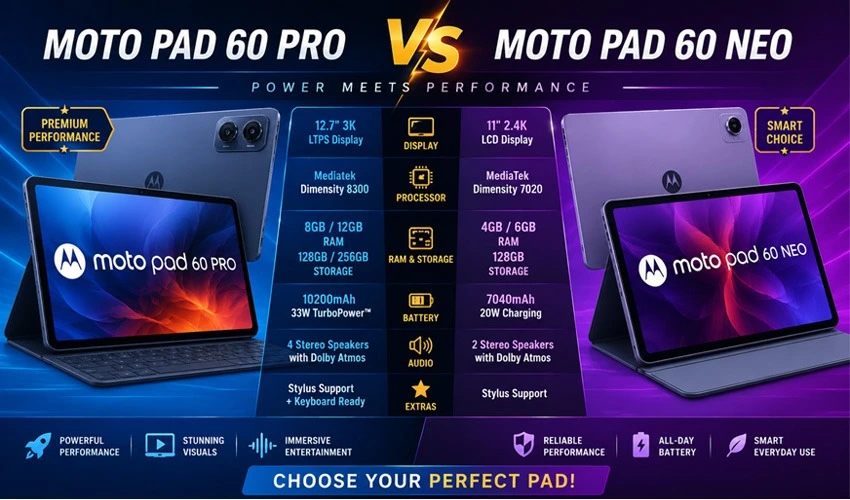
The Moto Pad 60 Pro is the flagship of the pair. It’s built around a 12.7-inch display, a more powerful MediaTek Dimensity 8300 chipset, and a massive 10,200mAh battery, positioning it as a genuine productivity and entertainment device. The Moto Pad 60 Neo, on the other hand, is the affordable sibling — an 11-inch tablet running a more modest Dimensity 6300 chipset, aimed squarely at casual users who mostly want something for streaming, browsing, and light multitasking.
On paper, the price difference between the two is significant enough that “value” isn’t just about which tablet is better — it’s about which tablet is better for you.
Display: Bigger and Sharper on the Pro
This is where the gap between the two devices is most obvious. The Moto Pad 60 Pro sports a 12.7-inch IPS LCD panel with a sharp 2944 x 1840 resolution and a 144Hz refresh rate, according to Smartprix listings. That combination makes scrolling, gaming, and stylus input feel noticeably smoother than what you’d get on a standard 60Hz tablet, and the higher pixel density means text and images look crisper for reading or design work.
The Moto Pad 60 Neo steps down to an 11-inch display. While exact resolution figures vary slightly across listings, it’s generally positioned as a standard-refresh-rate panel aimed at everyday content consumption rather than high-performance visual work. It’s still a perfectly usable screen for watching shows, reading, or browsing — but if you’re someone who cares about smoothness, color accuracy, or screen real estate for split-screen multitasking, the Pro’s display is in a different league.
Verdict: If display quality is a priority — especially for note-taking, digital art, or binge-watching — the Pro justifies its higher price here alone.
Performance: Dimensity 8300 vs Dimensity 6300
Under the hood, this is arguably the biggest functional difference between the two tablets.
The Moto Pad 60 Pro runs on MediaTek’s Dimensity 8300-Ultra chipset, paired with an ARM Mali-G615 MC6 GPU and up to 12GB of RAM. This is a genuinely capable mobile processor — the kind you’d expect to find in a mid-range flagship phone, not a budget tablet. It comfortably handles multitasking, moderately demanding games, and productivity apps without hiccups.
The Moto Pad 60 Neo uses the Dimensity 6300 instead, a chipset built around two ARM Cortex-A76 performance cores and six efficiency-focused Cortex-A55 cores. It’s worth noting that the Dimensity 6300 is very similar to the older Dimensity 6080, which tells you it’s designed for efficiency and everyday tasks rather than raw horsepower. It’ll handle web browsing, video streaming, social media, and basic productivity work just fine, but it’s not built for heavier gaming or intensive multitasking. Notebookcheck
RAM configurations also differ. The Neo is available in 4GB, 8GB, and even a rarer configuration in some markets, while the Pro focuses on 8GB and 12GB options. If you’re the type of person who keeps a dozen browser tabs and three apps open simultaneously, the Pro’s extra headroom will matter more than it sounds.
Verdict: The Pro wins decisively for anyone doing real multitasking, gaming, or creative work. The Neo is fine — even good — for lighter, single-task usage.
Battery Life: Both Impress, Pro Edges Ahead
Battery capacity is one area where Motorola clearly didn’t cut corners on either model.
The Moto Pad 60 Pro packs a 10,200mAh battery, and real-world testing suggests it can deliver up to 17 hours of video playback and over 13 hours of web browsing in typical usage — genuinely impressive numbers for a tablet this size. It also supports 45W fast charging, so topping it back up doesn’t take all day. Nexafeed
The Moto Pad 60 Neo isn’t far behind on paper, featuring a 7040mAh battery according to GSMArena’s listing. That’s still a healthy capacity for an 11-inch tablet, and given the less power-hungry chipset and (presumably) lower-resolution display, actual endurance per charge cycle may end up fairly comparable in casual use, even if the Pro has more capacity in reserve.
Verdict: Both tablets are built for all-day use, but the Pro has more raw capacity and faster charging, giving it a slight edge for power users who are away from an outlet for long stretches.
Cameras: Neither Is the Main Selling Point
Let’s be honest — nobody buys a tablet for its camera. That said, it’s worth knowing what you’re getting.
The Moto Pad 60 Pro includes a 13MP rear camera with autofocus and LED flash, along with an 8MP front camera for video calls. Reviewers have noted that the camera system is basic for the price, which is a fair criticism — but it gets the job done for document scanning, video calls, and casual photos. Nexafeed
Specific camera details for the Neo are less prominently documented, but given its positioning as the budget option, it’s reasonable to expect a comparable or slightly less capable setup. If camera quality is a dealbreaker for you, neither tablet is likely to wow you — this segment of the market simply doesn’t prioritize photography.
Verdict: Roughly a wash. Don’t buy either tablet expecting camera performance to be a highlight.
Software, Stylus, and Ecosystem Features
Both tablets run on Android, giving you access to the full Google Play ecosystem, though the Pro ships with the more recent Android 14 build alongside near-stock software with minimal bloatware.
One standout feature of the Pro is its included stylus support. The Moto Pen Pro offers ultra-low latency, 4096 pressure levels, and tilt support, making it a legitimately useful tool for note-taking or digital sketching — not just a gimmick bundled in for marketing purposes. The Pro also benefits from Motorola’s Smart Connect ecosystem, which includes features like Cross Control for operating your tablet and PC together, and Swipe to Stream for quickly moving content between devices. Nexafeed
The Neo, being the entry-level model, doesn’t emphasize these premium software extras in the same way. It’s built to be a straightforward, no-frills tablet experience — which, depending on your needs, might be exactly what you want.
Verdict: If you plan to use your tablet for note-taking, sketching, or you’re already invested in Motorola’s phone-to-tablet ecosystem, the Pro’s software extras add real value.
Price: The Deciding Factor
This is ultimately where the “value” question gets answered. Pricing varies by region and retailer, but a consistent pattern emerges across listings: the Neo consistently undercuts the Pro by a meaningful margin — in some markets by close to 30-40% depending on configuration. In India, for example, comparison listings put the Neo’s starting price notably below the Pro’s, a pattern that repeats across other regions as well.
That price gap isn’t small, and it directly reflects the hardware differences discussed above — a weaker chipset, a smaller screen, and fewer premium software features on the Neo.
So, Which One Offers Better Value?
The honest answer depends on how you plan to use the tablet.
Choose the Moto Pad 60 Pro if:
- You want a sharp, high-refresh-rate display for reading, streaming, or creative work
- You need serious multitasking or moderate gaming performance
- Stylus support and note-taking matter to you
- You’re willing to pay more for meaningfully better hardware
Choose the Moto Pad 60 Neo if:
- Your primary use case is streaming, browsing, and social media
- You want the lowest possible price for a Motorola tablet
- You don’t need top-tier performance or a premium display
- You’re buying a secondary device or a tablet for a child or casual household use
In terms of pure price-to-performance ratio, the Moto Pad 60 Neo technically offers better raw value — you’re getting a usable, capable tablet for considerably less money, and for the average person who just wants to watch videos and browse the web, it does the job well.
However, if you factor in longevity, versatility, and the noticeably better display and performance, the Moto Pad 60 Pro is the smarter long-term investment for anyone who plans to use their tablet for more than casual media consumption. The extra money buys you a device that won’t feel outdated or sluggish within a year or two.
For most buyers weighing genuine day-to-day utility against cost, the Pro represents the better overall value — but budget-focused shoppers who know exactly what they need will find the Neo hard to argue with.