










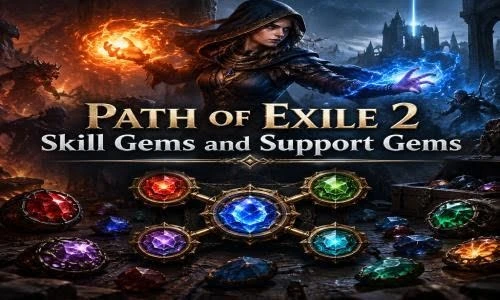
If you are coming to Path of Exile 2 from another ARPG, the Skill Gem system can take some time to get used to. I had to change the way I thought about skills because simply finding a strong ability is only part of building a character.
In PoE2, the Support Gems attached to a Skill can have just as much impact on how a build plays. A good combination can make an average skill feel much better, while the wrong Support can waste both a socket and valuable resources.
That is why I prefer to look at the whole setup instead of searching for a single “best” Support Gem.
How Skill Gems and Support Gems Work
Skill Gems provide the active abilities your character uses. Depending on the build, these can include attacks, spells, movement abilities, utility skills, or other forms of combat.
Your character can use a wide range of Skills as long as the necessary level, attribute, weapon, or other requirements are met.
Support Gems work differently. They modify compatible Skills rather than giving you another active ability.
For example, a Skill that already has good damage but feels slow may benefit more from a speed-related Support than another raw damage modifier. Likewise, a projectile Skill designed for clearing packs may gain more from a projectile or area modifier than from a Support focused entirely on single-target damage.
The important thing is to understand what your skill is actually trying to do.
Getting Skill Gems and Support Gems
Uncut Skill Gems and Uncut Support Gems give you more control over character progression. Instead of relying entirely on finding a finished gem, you can use the Gemcutting system to select options that fit your build.
The Gemcutting interface is particularly useful when experimenting because you can check available Skills and Supports before spending resources.
Your Support sockets also become increasingly important as the character develops. Jeweller’s Orbs can be used to increase Support capacity, allowing a main Skill to benefit from more modifiers.
This is one reason I wouldn’t spend all of my POE2 Currency as soon as I get it. During leveling, resources are better used when they solve an actual problem with the character rather than simply making every Skill look more complete.
When Should You Add More Support Sockets?
More sockets are useful, but not every Skill deserves the same investment.
I usually prioritize them like this:
- Identify the Skill that provides most of your damage.
- Add supports that directly improve its mechanics.
- Increase its Support capacity when the cost is reasonable.
- Improve secondary Skills afterward.
- Leave minor utility Skills alone until they actually need an upgrade.
This approach keeps the build focused and prevents you from spreading resources too thin.
How to Choose the Right Support
There isn’t a universal Support Gem that works for every build.
Before adding one, I normally ask three simple questions:
- What does this Skill scale with?
- What is the Skill’s main purpose?
- What problem am I trying to solve?
That last question matters more than it sounds.
If a Skill already has enough damage but poor clear speed, adding another damage modifier may not make much difference. A Support that improves area coverage, projectiles, or speed could have a much bigger impact on actual gameplay.
Damage Supports
Damage Supports are an obvious choice for many main Skills.
Physical attacks generally want modifiers that work with their physical scaling, while elemental skills benefit from effects that match their damage type.
However, I wouldn’t choose a Support simply because its description contains a large damage number. The interaction with the Skill matters more than the number in isolation.
Attack and Cast Speed
Speed is another stat that can be easy to underestimate.
A faster attack can make melee combat feel smoother, while faster casting can reduce the time a spellcaster spends standing still.
There is a downside, though. Using an ability more frequently can increase resource consumption. If your build already has resource problems, adding more speed may create another issue instead of solving the first one.
Area and Projectile Effects
These Supports are especially useful for clearing groups of enemies.
A projectile Skill can feel completely different after changing how its projectiles behave. Similarly, an area-focused setup can make regular encounters much more comfortable.
The trade-off is that clearing and boss damage don’t always want the same setup.
For that reason, I prefer giving different skills to different jobs instead of forcing one ability to handle every situation.
Ailments and Elemental Builds
Ailment-focused characters require a little more planning.
If a build revolves around effects such as Ignite, Freeze, or Poison, the Supports should reinforce that mechanic.
Before choosing a Support, check the Skill’s tags and mechanics. They can quickly tell you whether a combination makes sense.
A Support may look powerful on its own but provide very little value if it doesn’t interact properly with the Skill.
This is also a good place to avoid wasting POE 2 Orbs and other resources on combinations that look good on paper but don’t improve the actual build.
Trigger and Meta Setups
Trigger and Meta mechanics are where the Skill system becomes considerably more interesting.
Instead of simply increasing the damage of one ability, you can create interactions between several Skills. One action can help activate or set up another effect, giving the character a more connected combat style.
For new players, I wouldn’t recommend starting with complicated Meta setups.
A better progression is:
- Build a reliable main Skill.
- Understand its Support interactions.
- Add utility and defensive skills.
Experiment with Meta mechanics once the basic setup feels comfortable.
Once you understand the fundamentals, these more complicated combinations become much easier to experiment with.
Practical Skill Setup Examples
I don’t like treating specific Support combinations as permanent recommendations because PoE2 can change over time. Instead, it is more useful to understand the basic logic behind different archetypes.
Physical Melee
For a physical melee Skill, I’d first look at:
Physical damage scaling
Attack speed
Effects that improve the Skill’s core mechanic
Resource efficiency when necessary
The goal is to strengthen what the attack already does well instead of adding unrelated effects.
Spellcaster
Spellcasters usually have more flexibility.
First decide whether the Skill is mainly for:
Clearing groups
Single-target damage
Elemental or ailment effects
Utility
Once that role is clear, choosing Support becomes much easier.
Projectile Builds
Projectile characters often need to balance clearing and single-target performance.
More projectiles or improved coverage can make normal maps much faster, but that doesn’t necessarily mean the same setup is ideal against bosses.
I generally prefer having a dedicated Skill for situations where the main clearing ability starts to struggle.
Minion Builds
Minion builds require a slightly different approach because your damage comes from your summoned units.
Damage is important, but survivability can be just as valuable. A minion that constantly dies won’t contribute much damage regardless of how strong its theoretical modifiers are.
Don’t Ignore Attribute Requirements
Support Gems can have their own attribute requirements, and these become more noticeable as your character progresses.
If a Support suddenly stops working after changing equipment or passive choices, check the requirements before changing the entire Skill setup.
This is an easy detail to overlook, especially when several pieces of gear are being upgraded at the same time.
I also wouldn’t assume that every available socket needs to be filled immediately. A smaller setup that works consistently is often better than a complicated setup that is difficult to maintain.
Don’t Upgrade Everything at Once
One of the easiest mistakes during leveling is trying to make every Skill equally powerful.
I used to spread resources across too many abilities because I wanted every button on the action bar to feel strong. In practice, that often left my main skill weaker than it should have been.
A better approach is to establish one reliable damage skill first.
Then build around it with:
A secondary damage option
Movement or mobility
Defensive Skills
Crowd control or utility
A bossing or clearing option if necessary
This also helps you use resources more efficiently instead of constantly spending POE2 Currency on upgrades that don’t have much impact.
Don’t Automatically Copy the Same Supports
PoE2 gives you plenty of freedom to use similar Support types on different Skills, but that doesn’t mean identical setups are always effective.
Two Skills can have similar tags while scaling very differently.
When testing a new Support, I prefer to put it on the Skill that matters most and see what happens in actual combat. If the difference is noticeable, then I’ll consider whether the same support makes sense elsewhere.
That approach is more useful than blindly copying a popular setup.
Common Mistakes to Avoid
There are a few mistakes that are especially easy to make when learning the system.
Choosing Supports based only on their names or descriptions.
A powerful-sounding Support isn’t necessarily useful for your Skill.
Ignoring compatibility.
Always check whether the Support actually works with the Skill before investing resources.
Focusing only on theoretical damage.
A slightly weaker setup may perform much better if it is easier to use and more reliable.
Spreading resources too widely.
Your main Skill should normally receive priority during progression.
Changing too many things at once.
If you replace several supports and pieces of equipment simultaneously, it becomes difficult to tell which change actually helped.
The Skill Gem and Support system can look complicated at first, but it becomes much easier once you stop searching for one universal list of “best” Supports.
Start with the Skill itself.
Look at what it does well, identify where it struggles, and decide what role you want it to play. From there, choose Supports that solve those problems.
That’s the part of PoE2 I enjoy most. The system gives you room to experiment without forcing every character into exactly the same setup.
The popular Skills and Support combinations will change over time, and the value of different POE 2 Orbs or other resources can change with the economy and progression stage as well. But understanding how Skills, Supports, sockets, attributes, and resources work together will remain useful no matter what build becomes popular next.
