








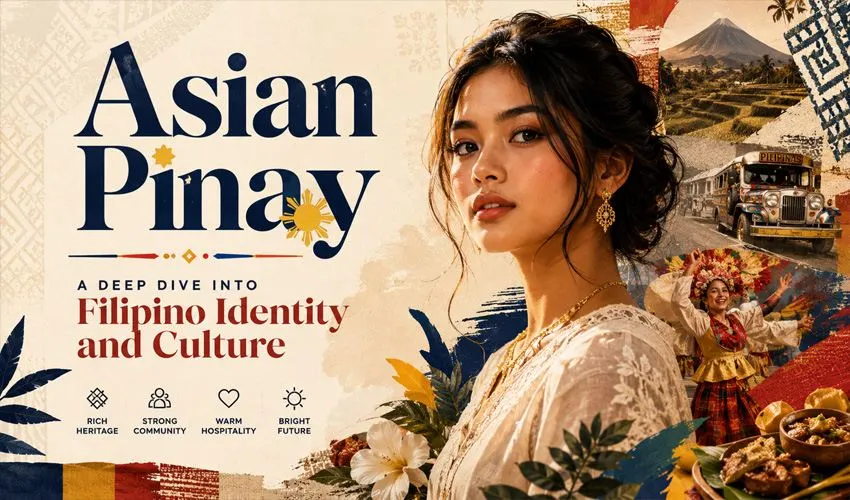
Introduction: Who Is the Asian Pinay?
The word Pinay carries within it an entire universe. It is a term of endearment, a badge of cultural pride, and a declaration of identity all rolled into two syllables. Short for Pilipina — the Filipino feminine form of Pilipino — “Pinay” is how Filipino women across the world refer to themselves when they want to affirm not just their nationality, but their spirit, their roots, and their sense of belonging to something larger than themselves.
To understand the Asian Pinay is to understand a woman shaped by one of the world’s most layered cultural histories. The Philippines, an archipelago of over 7,600 islands in Southeast Asia, has been a crossroads of civilizations for centuries. Indigenous Austronesian traditions, centuries of Spanish colonial influence, American cultural imprints, Chinese mercantile roots, and Islamic heritage in the south have all converged to create something truly unique: a Filipino identity that is neither purely Eastern nor Western, but distinctly and beautifully its own.
This article takes a deep dive into what it means to be a Pinay in the modern world — exploring identity, values, language, the diaspora experience, resilience, and the evolving definition of Filipino womanhood.
The Historical Roots of Filipino Female Identity
Long before Spanish colonizers arrived in 1565, Filipino women occupied positions of significant power and reverence. In pre-colonial Philippine society, women known as babaylan served as spiritual leaders, healers, and community anchors. These women held authority that cut across the social fabric — they were the keepers of oral tradition, the conduits between the physical and spiritual worlds, and respected voices in matters of governance and justice.
The arrival of Spanish colonialism dramatically reshaped this landscape. The Catholic Church became the dominant cultural institution, and with it came new frameworks around femininity, modesty, and domesticity. The image of the Maria Clara — drawn from José Rizal’s novel Noli Me Tangere — became the colonial ideal of Filipino womanhood: demure, pious, loyal, and self-sacrificing. This archetype was imposed, but Filipino women were never entirely confined by it. Beneath the surface, the spirit of the babaylan endured.
American colonization in the early 20th century brought public education, English as a medium of instruction, and new models of womanhood influenced by Western liberalism. Filipino women began entering universities, professions, and public life in greater numbers. Yet the tension between indigenous strength, colonial modesty, and modern ambition remains a defining feature of Pinay identity to this day.
Language as Identity: The Power of Filipino Expression
Language sits at the heart of Pinay identity. Filipino (based on Tagalog) is the national language, but the Philippines is home to over 180 languages and dialects — Cebuano, Ilocano, Hiligaynon, Waray, Kapampangan, and more. For many Pinays, the language they speak at home is as much a part of their identity as the food they eat or the saints they pray to.
The phenomenon of Taglish — the seamless blending of Tagalog and English in everyday conversation — is a linguistic signature of the modern Pinay. Far from being seen as a corruption of either language, Taglish is a creative and adaptive form of expression that mirrors the hybridity of Filipino identity itself. It is fluid, expressive, and deeply social.
Terms of endearment like anak (child), mahal (love/expensive — a poignant double meaning), and ate (older sister) reflect a worldview in which relationships are central. The Filipino language is relationally oriented; it encodes social hierarchy, warmth, and community in ways that English simply cannot replicate.
Core Values: What Shapes the Pinay Soul
Several deeply held values shape the way Filipino women navigate their lives, relationships, and communities. Understanding these values is essential to understanding the Pinay experience.
Kapwa — often translated as “shared identity” or “the self in the other” — is perhaps the most fundamental Filipino value. It reflects a worldview in which the individual is never truly separate from the community. For Pinays, this manifests in a profound sense of collective responsibility, generosity toward family and friends, and a deep discomfort with conflict that disrupts communal harmony.
Utang na loob, or the debt of inner gratitude, governs how Pinays relate to those who have helped them — particularly parents and elders. It is not merely a transaction but an acknowledgment that care creates bonds that run deeper than obligation.
Hiya, roughly translated as “shame” or social propriety, functions as a moral compass that keeps behavior in alignment with community expectations. While it has sometimes been used to police women’s autonomy, it is also a sophisticated social technology that preserves dignity and mutual respect.
Bayanihan — the spirit of communal unity and cooperation — is perhaps the most celebrated Filipino value internationally. Originally describing the practice of neighbors helping a family move their house by literally carrying it together, bayanihan today represents the Filipino instinct to rally around those in need. Pinays embody this value in countless ways, from remittances sent home to families abroad, to mutual aid networks within Filipino diaspora communities worldwide.
The Diaspora Pinay: Identity Across Borders
Today, an estimated 10 to 12 million Filipinos live outside the Philippines, making the Filipino diaspora one of the largest in the world. Among them are millions of Pinays who have built lives in the United States, Canada, the United Kingdom, Hong Kong, Singapore, the Middle East, and beyond.
The diaspora Pinay occupies a complex and often contradictory space. She is frequently the economic backbone of her family — sending remittances that account for nearly ten percent of the Philippines’ GDP. She is a caregiver, a professional, a student, an entrepreneur. She navigates the tension between preserving her cultural heritage and adapting to new social landscapes. She is asked, repeatedly, to explain herself: her food, her accent, her customs, her faith.
For many diaspora Pinays, identity becomes a conscious project. They may cling to traditions more fiercely than those who stayed behind, or they may feel estranged from a homeland they know only through stories and visits. Second-generation Pinays — born or raised abroad — often describe a hyphenated identity, being Filipino-American or British-Filipino, where both halves are real and neither is complete without the other.
Social media has transformed how diaspora Pinays maintain their cultural identity. Filipino food content, language learning communities, OPM (Original Pilipino Music) playlists, and online spaces where Pinays share their experiences have created a virtual homeland that transcends geography.
Resilience and the Pinay Spirit
If there is one quality that cuts across all the diversity of Pinay experience, it is resilience. The Filipino word diskarte — a street-smart adaptability, the ability to find a way through any situation — is something Pinays are raised to embody.
The Philippines is one of the most disaster-prone nations on Earth, regularly battered by typhoons, earthquakes, and volcanic eruptions. Filipino communities, and Filipino women in particular, have developed extraordinary capacities for rebuilding, for bangon — rising again. The same resilience that helps a community recover from a typhoon also helps a Pinay navigate workplace discrimination abroad, or rebuild a life after loss, or raise children alone while a spouse works overseas.
This resilience is not mere stoicism. It is animated by humor — Filipinos are famous for their ability to find laughter even in hardship — and by faith. The Philippines is the third-largest Catholic country in the world, and for many Pinays, faith is not a Sunday obligation but a daily conversation with the divine that sustains them through difficulty.
Modern Pinay: Breaking Boundaries and Redefining Identity
The modern Pinay is rewriting the script. She is a senator and a Supreme Court justice, a global CEO and an internationally acclaimed writer. She is a content creator reclaiming Filipino beauty standards, a chef introducing the world to adobo and sinigang, an activist challenging political authoritarianism.
She is also questioning inherited norms. Conversations around gender equality, reproductive rights, mental health, colorism (the preference for lighter skin tones, a colonial legacy that many Pinays are actively challenging), and the burden of caregiving are increasingly loud in Filipino public discourse. A new generation of Pinays is asking what it means to love their culture while also critiquing the parts of it that have limited them.
The beauty industry’s obsession with whitening products in the Philippines is being contested by a growing morena pride movement, celebrating darker skin tones as beautiful and authentically Filipino. The image of the Maria Clara is being updated — not abandoned, but expanded — to make room for Pinays who are bold, ambitious, sexually autonomous, and unapologetically themselves.
Food, Faith, and Fiesta: The Cultural Pillars
No exploration of Pinay identity is complete without acknowledging the central role of food, faith, and celebration. Filipino cuisine — with its bold flavors, its love of sour (sinigang), sweet (leche flan), and umami (bagoong) — is an act of love and memory. For Pinays, cooking is rarely solitary; it is communal, intergenerational, and deeply tied to belonging.
The fiestas that mark the Filipino calendar are explosions of communal joy — and they are largely organized, sustained, and brought to life by women. From the Sinulog in Cebu to the Pahiyas in Quezon province, these celebrations are expressions of a cultural vitality that no amount of historical disruption has been able to extinguish.
Faith, predominantly Catholic but also Protestant, Muslim, and indigenous in various communities, provides Pinays with a framework for suffering, hope, and communal life. The simbang gabi (night masses leading up to Christmas), the elaborate Holy Week traditions, the devotion to the Black Nazarene — these are not just religious observances but cultural events that knit communities together across class and generation.
Conclusion: The Pinay in the World
To be a Pinay is to carry multitudes. It is to be the inheritor of a pre-colonial tradition of feminine power, a survivor of colonial redefinition, a navigator of diaspora and displacement, and a builder of new identities in a changing world. It is to hold together, in a single self, warmth and strength, tradition and reinvention, faith and doubt, rootedness and restlessness.
The Asian Pinay is not a fixed image or a single story. She is a kapwa — a self-in-relation — whose identity is always being shaped by and shaping the world around her. In her resilience, her humor, her generosity, her hunger for justice, and her fierce love for her people, she embodies something that the world increasingly needs: the knowledge that identity is not a limitation, but a source of boundless strength.