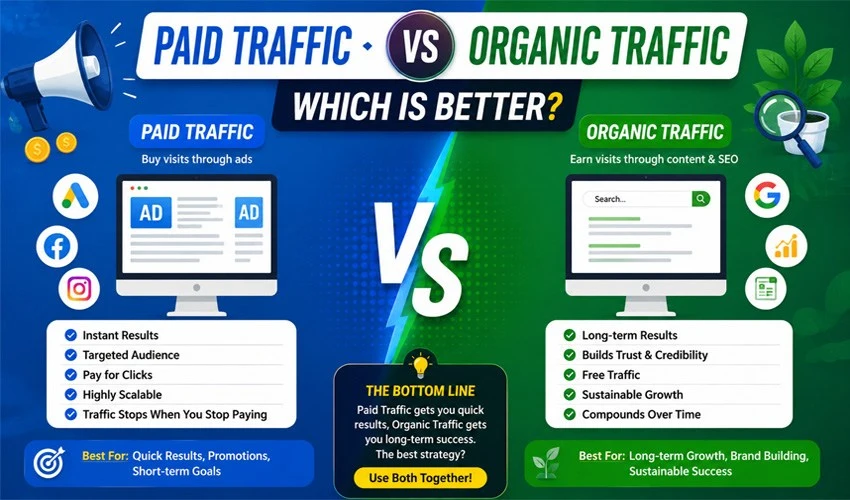








Organic growth is valuable, but it’s slow, and most businesses can’t afford to wait months or years for search rankings and social followings to build momentum. Paid traffic offers something organic strategies can’t: immediate, controllable, and scalable visibility. The challenge isn’t whether to use paid traffic — it’s knowing which sources actually align with your business model, audience, and goals, since the wrong platform can burn through budget with little to show for it.
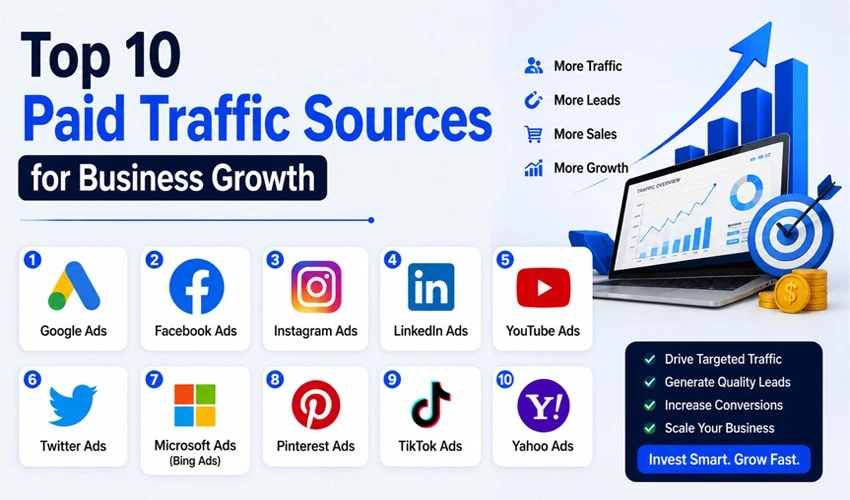
This article breaks down 10 of the most effective paid traffic sources available today, what each one is genuinely good at, and the kind of business that tends to get the best return from it.
1. Google Search Ads
Google Search Ads remain one of the most reliable paid traffic sources because they capture demand at the exact moment someone is actively searching for a solution. Unlike most other channels, search ads don’t need to interrupt or persuade — they simply show up when intent already exists, which tends to produce higher conversion rates compared to more passive advertising formats.
This makes Google Search particularly effective for businesses with clear, well-defined search demand: service providers, e-commerce stores selling specific products, SaaS tools solving known problems, and local businesses like clinics, law firms, or contractors. The trade-off is cost — competitive keywords in crowded industries can carry a high cost-per-click, which means campaigns need tight targeting, strong ad copy, and a landing page built to convert, or the spend simply won’t pay for itself.
2. Google Display Network
While search ads capture existing intent, the Google Display Network is built for reaching people before they’re actively searching — placing visual ads across millions of websites, apps, and video content that partner with Google’s ad network. Display advertising tends to work best for brand awareness, retargeting website visitors who didn’t convert on their first visit, and nurturing prospects earlier in the buying journey.
Retargeting in particular is one of the most cost-effective uses of Display ads: showing tailored ads to people who already visited your site but left without converting typically produces a much lower cost per acquisition than cold traffic, since the audience already has some familiarity with your brand.
3. Meta Ads (Facebook and Instagram)
Meta’s advertising platform, covering both Facebook and Instagram, remains one of the most versatile paid traffic sources thanks to its detailed audience targeting options and strong creative formats, including image, video, carousel, and Reels ads. Meta Ads work particularly well for businesses that rely on visual storytelling — e-commerce brands, consumer products, lifestyle and wellness businesses, and local service providers targeting a specific demographic or geography.
Because Meta’s algorithm is built to optimize toward specific outcomes — purchases, leads, app installs, or engagement — campaigns tend to improve in efficiency over time as the platform gathers more conversion data. This makes Meta Ads a strong fit for businesses that can commit to a testing budget upfront rather than expecting immediate efficiency from day one.
4. LinkedIn Ads
For B2B businesses, LinkedIn Ads offer something no other platform can fully replicate: precise targeting based on job title, seniority, industry, company size, and professional skills. This makes LinkedIn especially effective for reaching decision-makers in enterprise sales, B2B SaaS, recruitment, financial services, and consulting.
The trade-off is cost — LinkedIn’s cost-per-click and cost-per-lead tend to run significantly higher than platforms like Meta or Google Display. This generally makes LinkedIn a better fit for businesses with a high customer lifetime value or high average deal size, where a smaller number of well-qualified leads can justify the higher acquisition cost.
5. Microsoft (Bing) Ads
Often overlooked in favor of Google, Microsoft Advertising runs on the Bing search network along with Yahoo and various syndicated partners. While its overall search volume is smaller than Google’s, Microsoft Ads often benefits from lower competition and therefore lower cost-per-click for many keywords, particularly in B2B, professional services, and older demographic segments that are more likely to use Microsoft’s default browser and search engine.
Businesses already running successful Google Search campaigns often find that porting similar campaigns to Microsoft Ads adds incremental, relatively low-cost traffic without requiring an entirely new strategy — making it a practical secondary channel rather than a primary one for most businesses.
6. YouTube Ads
As the second-largest search engine in terms of query volume, YouTube offers a unique blend of search-based and interest-based targeting through video content. YouTube Ads range from short, skippable in-stream ads to non-skippable formats and discovery ads that appear alongside search results and related videos.
Video advertising tends to perform particularly well for products or services that benefit from demonstration or storytelling — software with a visual interface, physical products with a clear before-and-after use case, or brands trying to build emotional connection rather than push a single transactional message. Because production quality matters more here than in text or static image ads, YouTube campaigns often require a larger upfront creative investment, but can produce strong brand recall and consideration when done well.
7. TikTok Ads
TikTok has evolved from a purely entertainment-focused app into a legitimate performance marketing channel, particularly for businesses targeting younger demographics. Its ad formats are built to blend naturally into the platform’s native short-form video content, which means ads that feel overly polished or traditionally “corporate” often underperform compared to ads that adopt the platform’s casual, authentic tone.
TikTok Ads tend to work best for consumer products, fashion, beauty, food and beverage, and entertainment-adjacent businesses that can produce engaging short-form content consistently. Because trends and content styles shift quickly on the platform, businesses that treat TikTok as a set-and-forget channel typically see performance decline faster than on more stable platforms like Google or Meta.
8. Native Advertising (Taboola, Outbrain, and similar networks)
Native advertising networks place sponsored content recommendations within the editorial layout of publisher websites, typically appearing as “you might also like” or “recommended for you” sections beneath articles. Because native ads are designed to visually match the surrounding content, they tend to generate higher engagement than traditional banner ads, which readers have become highly skilled at ignoring.
This channel works well for content-driven businesses — publishers, media companies, and businesses running top-of-funnel content marketing campaigns designed to build awareness or capture email sign-ups rather than drive immediate purchases. Native advertising generally isn’t the strongest fit for direct, hard-sell conversion campaigns, since the format is built around softer content engagement rather than transactional intent.
9. Programmatic Display Advertising
Programmatic advertising uses automated, algorithm-driven bidding to purchase display ad space across a vast network of websites and apps in real time, often through demand-side platforms that give advertisers access to inventory far beyond what a single ad network like Google Display can offer. This approach allows for highly granular targeting based on behavioral data, contextual relevance, and audience segments built from first- or third-party data.
Programmatic advertising tends to suit larger businesses with bigger budgets and more sophisticated marketing operations, since it typically requires either a dedicated platform subscription or an agency partner to manage effectively. For businesses that have outgrown the targeting capabilities of standard ad platforms and need broader reach with precise audience control, programmatic display can be a powerful, if more complex, addition to the paid media mix.
10. Amazon Ads
For businesses selling physical products, Amazon Ads offer a distinct advantage: the audience is already in a buying mindset, actively searching for products to purchase rather than browsing passively. Amazon’s ad formats include sponsored product listings, sponsored brand placements, and display ads that can run both on and off the Amazon platform.
This channel is particularly effective for e-commerce brands with products already listed on Amazon, since ads can appear directly within search results and product pages where shoppers are making immediate purchase decisions. Even businesses that primarily sell through their own website often find Amazon Ads useful as an additional revenue channel or as a way to build product visibility and reviews that reinforce credibility elsewhere.
Choosing the Right Mix for Your Business
With so many paid traffic sources available, the biggest mistake most businesses make isn’t picking the “wrong” platform — it’s spreading a limited budget too thin across too many channels before any single one has been given a fair chance to prove itself. A more effective approach is to start with one or two channels that most closely match your business model and audience behavior, get those campaigns performing efficiently, and only then expand into additional channels once you have a clear picture of what’s working.
A few practical guidelines can help narrow the starting point:
- If you’re selling something people actively search for — a specific product, service, or solution to a known problem — Google Search Ads or Amazon Ads (for physical products) are usually the strongest starting point, since they capture existing demand rather than trying to create it.
- If your product benefits from visual demonstration or storytelling, platforms like Meta, YouTube, or TikTok tend to perform better, since they’re built around engaging content rather than direct search queries.
- If you’re selling to businesses rather than consumers, LinkedIn Ads typically offer the most precise targeting, even though the cost per click is higher, because the quality and relevance of the audience can offset the higher acquisition cost.
- If your business relies on content marketing and top-of-funnel awareness, native advertising networks can help distribute that content to a much wider audience than organic reach alone would allow.
Measuring What Actually Matters
Regardless of which channels you choose, the same measurement discipline applies across all of them. Track cost per acquisition, not just cost per click, since a cheap click that never converts is a poor use of budget compared to a more expensive click that reliably turns into a customer. Pay attention to customer lifetime value alongside acquisition cost, since a channel that looks expensive on a per-lead basis can still be highly profitable if it consistently brings in higher-value, longer-retained customers.
It’s also worth building in a testing budget for any new channel before scaling spend. Paid traffic sources vary enormously in how quickly they respond to creative changes, audience refinement, and bidding strategy adjustments, and giving a new channel too little time or budget to gather meaningful data is one of the most common reasons businesses conclude a platform “doesn’t work” for them when the real issue was an underpowered test.
Final Thoughts
There’s no universal best paid traffic source — the right choice depends on what you’re selling, who you’re selling to, and how much runway you have to test and optimize before expecting strong returns. The businesses that get the most out of paid traffic tend to be the ones that resist spreading their budget too thin, commit to properly testing a smaller number of well-matched channels, and consistently measure performance against real business outcomes rather than surface-level engagement metrics.
Built thoughtfully, a diversified paid traffic strategy — even if it eventually spans several of the channels covered here — can become one of the most reliable and scalable growth levers available to a business, complementing organic efforts rather than replacing them.