








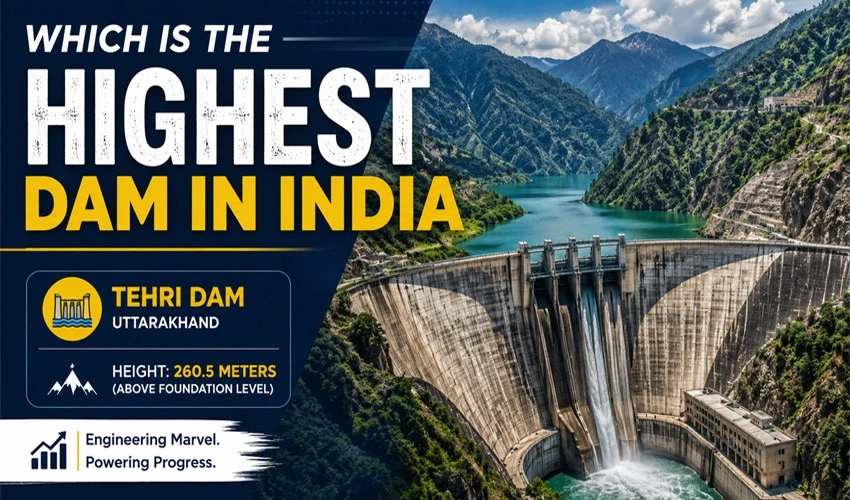
India’s rivers have been tamed, harnessed, and shaped by some of the most ambitious engineering projects in the world. From the icy streams of the Himalayas to the wide plains of the Deccan, dams have quietly powered the nation’s growth for over a century. Among the thousands of dams dotting the Indian landscape, one structure towers above every other in sheer height — the Tehri Dam.
Standing at an impressive 260.5 metres (855 feet), the Tehri Dam is officially recognized as the highest dam in India and ranks among the tallest dams anywhere in the world. This article takes a close look at the Tehri Dam, its history, engineering, importance, and how it compares to other major dams across the country.
The Tehri Dam: India’s Tallest Structure
The Tehri Dam is located near the town of New Tehri in the Tehri Garhwal district of Uttarakhand, roughly 200 kilometres north of Delhi. It is built across the Bhagirathi River, one of the primary headstreams of the Ganga, in a region where the Himalayan foothills give way to deep, narrow gorges — ideal terrain for a dam of this scale.
Unlike concrete gravity dams that rely on sheer mass and rigidity, Tehri is a rock and earth-fill embankment dam. This means its core is built from a combination of compacted earth, clay, and rock material rather than poured concrete. This design choice makes it more flexible and better suited to the seismically active Himalayan zone in which it stands, since it can absorb ground movement more effectively than a rigid concrete structure.
Key Statistics of the Tehri Dam
- Height: 260.5 metres (855 feet)
- Length: 575 metres
- Crest width: 20 metres
- Base width: approximately 1,128 metres
- River: Bhagirathi (a major tributary of the Ganga)
- Type: Rock and earth-fill embankment dam
- Reservoir capacity: Around 3.5 to 4 billion cubic metres of water
- Reservoir surface area: Roughly 52 square kilometres
- Installed hydropower capacity: 1,000 MW, with an additional 1,000 MW pumped-storage scheme
These numbers place Tehri not just as India’s tallest dam, but as one of the tallest dams on the planet, often cited among the top ten to fifteen highest dams worldwide depending on the measurement criteria used.
A Long and Difficult Journey to Completion
Few infrastructure projects in India have taken as long, or generated as much debate, as the Tehri Dam. The idea for the dam was first studied way back in 1961, and detailed planning continued through the following decade. Construction formally began in 1978, but the project moved slowly for years due to a combination of financial constraints, technical challenges, and growing environmental opposition.
In the mid-1980s, the erstwhile Soviet Union provided technical and financial assistance for the project, but this support was disrupted following the political upheaval that led to the USSR’s collapse. India then had to shoulder the responsibility of completing the dam on its own. The Tehri Hydro Development Corporation (THDC) was formed in 1988 specifically to manage the project, with the central government funding the majority of the cost and the Uttar Pradesh state government (Uttarakhand had not yet been carved out as a separate state at that time) covering the rest, along with the irrigation component.
After decades of construction, environmental review, and social rehabilitation efforts, the dam was finally completed in 2006 — nearly 28 years after work began. In 2019, control of THDC was transferred to NTPC Limited, one of India’s largest power generation companies, marking a new chapter in the dam’s operational history.
Why Was the Tehri Dam Built?
The Tehri Dam is a multipurpose project, meaning it wasn’t constructed for a single objective but to serve several critical functions simultaneously:
- Hydroelectric Power Generation – The dam’s power complex has a combined generation capacity that has been expanded over time, supplying much-needed electricity to northern Indian states, including Uttar Pradesh, Uttarakhand, Delhi, and neighboring regions.
- Irrigation – Water released from the reservoir supports agriculture across a substantial stretch of the Gangetic plains, helping farmers maintain steady crop yields even during drier months.
- Drinking Water Supply – A significant share of Delhi’s municipal water needs is met through water diverted from the Tehri reservoir, underlining just how far-reaching the dam’s impact is beyond its immediate region.
- Flood Control – By regulating the flow of the Bhagirathi River, the dam helps reduce the risk of downstream flooding during the monsoon season, protecting settlements and farmland along the riverbanks.
- Pumped Storage Hydroelectricity – Tehri also houses a pumped-storage scheme, a system that stores energy by pumping water uphill during low-demand periods and releasing it to generate power during peak demand, adding valuable flexibility to the northern power grid.
The Human and Environmental Cost
No discussion of the Tehri Dam would be complete without acknowledging the controversy that surrounded its construction. The reservoir created by the dam submerged the old town of Tehri entirely, displacing thousands of residents who had lived there for generations. A new settlement, New Tehri, was built on higher ground to rehabilitate the displaced population, though the transition was far from smooth for many families.
Environmental activists, most notably Sunderlal Bahuguna, led a sustained movement against the dam from the 1980s until the early 2000s. Concerns raised included the ecological impact on the Bhagirathi, which is considered a sacred part of the Ganga river system, the seismic risks of building such a massive structure in an earthquake-prone zone, and the broader question of whether the benefits justified the human displacement involved.
Despite the protests, the project moved forward and was eventually completed, and it continues to operate today. The debate around Tehri remains a frequently cited case study in India when discussing the trade-offs between large infrastructure development and environmental or social costs.
How Tehri Compares to Other Major Indian Dams
While Tehri holds the title for height, it’s worth understanding how it stacks up against other well-known Indian dams, each of which is significant in its own right for different reasons.
- Bhakra Nangal Dam (Sutlej River, Himachal Pradesh/Punjab border): Standing at around 225–226 metres, this gravity dam is the second-tallest in India and one of the largest in Asia by reservoir volume. Its reservoir, Gobind Sagar, is among the largest in the country.
- Sardar Sarovar Dam (Narmada River, Gujarat): At roughly 163 metres, this dam is known less for its height and more for its vast irrigation canal network, which spans multiple states including Gujarat, Madhya Pradesh, Maharashtra, and Rajasthan.
- Hirakud Dam (Mahanadi River, Odisha): While not particularly tall, Hirakud is famous for being one of the longest dams in the world, stretching close to 26 kilometres, and was one of independent India’s first major river valley projects.
- Nagarjuna Sagar Dam (Krishna River, Telangana/Andhra Pradesh): Known as one of the largest masonry dams in the world, it plays a vital role in irrigation across the Krishna river basin.
- Idukki Arch Dam (Periyar River, Kerala): A striking double-curvature arch dam built between two mountains, notable for its architectural design rather than sheer scale.
This comparison shows that “biggest” in the context of Indian dams can mean different things — tallest, longest, largest reservoir, or most powerful — and Tehri specifically claims the crown for height.
Tehri Today: More Than Just a Dam
Beyond its engineering and utility functions, the Tehri Dam has also become a significant tourist destination. The reservoir, known as Tehri Lake, offers a stunning backdrop of green Himalayan hills and has developed into a hub for adventure tourism. Visitors can enjoy activities such as jet skiing, parasailing, and water zorbing, making the region a popular weekend getaway for travelers from Delhi and nearby cities.
The dam also remains central to India’s energy strategy for the northern grid. With its combination of conventional hydropower and pumped-storage capability, Tehri continues to play an important role in balancing electricity supply and demand, particularly as India works to integrate more renewable energy sources into its power system, which require flexible backup generation.
Conclusion
The Tehri Dam’s position as the highest dam in India is well established, both in terms of official records and its outsized role in the country’s energy, irrigation, and water supply systems. Its story is one of ambition and controversy in equal measure — nearly three decades in the making, shaped by geopolitical shifts, financial hurdles, and passionate environmental activism, yet ultimately delivering power and water to millions of people across northern India.
Whether viewed purely as an engineering marvel, a case study in development trade-offs, or a scenic tourist destination nestled in the Himalayan foothills, the Tehri Dam remains one of the most significant structures in India’s modern infrastructure story — and, at 260.5 metres, its tallest dam by a clear margin.