








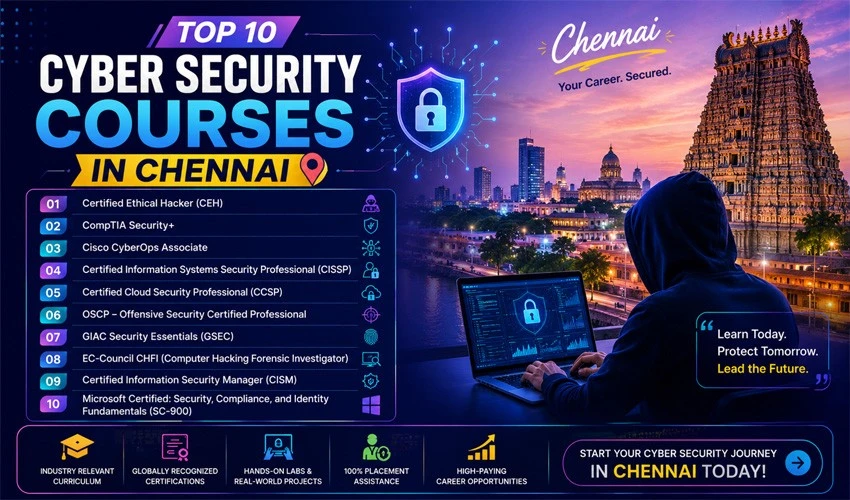
Chennai has quietly become one of South India’s most important IT and technology hubs, home to global capability centers, banking and fintech operations, automotive giants, and a fast-growing startup ecosystem. With this digital expansion comes a parallel and urgent need: protecting systems, networks, and data from an ever-evolving landscape of cyber threats. As a result, the demand for skilled cyber security professionals in Chennai has surged dramatically over the past few years.
Whether you’re a fresh graduate, an IT professional looking to pivot, or someone from a non-technical background hoping to break into this lucrative field, choosing the right training program is the first and most critical step. Chennai offers a wide spectrum of options — from short-term certification programs to comprehensive diploma courses and globally recognized certifications delivered through local training partners.
This article walks you through ten of the most sought-after cyber security courses available in Chennai, what they typically cover, and how to decide which one fits your career goals.
Why Chennai Is a Great Place to Learn Cyber Security
Before diving into the list, it’s worth understanding why Chennai stands out as a training destination for this field. The city hosts a dense concentration of IT parks, including those in OMR, Ambattur, and Guindy, along with a strong presence of banking, insurance, and healthcare companies that require robust security teams. This creates a healthy local job market for freshly trained professionals, meaning many institutes design their courses with direct placement partnerships in mind. Additionally, the cost of quality technical education in Chennai remains more affordable compared to metros like Bangalore or Mumbai, without compromising on training quality.
1. Certified Ethical Hacker (CEH) Training Programs
The CEH certification, offered globally by EC-Council, remains one of the most recognized entry points into ethical hacking and penetration testing. Several training institutes in Chennai offer CEH preparation courses that cover reconnaissance techniques, scanning networks, system hacking, malware analysis, and web application vulnerabilities. These courses are ideal for those who want an internationally portable credential and typically run for 4 to 8 weeks, often including hands-on lab access and exam voucher assistance.
2. CompTIA Security+ Certification Training
For beginners who want a strong theoretical and practical foundation before jumping into offensive security, CompTIA Security+ is often recommended as a starting certification. Training centers in Chennai that partner with CompTIA typically structure this course around core security concepts, risk management, cryptography basics, and network security fundamentals. It’s a good fit for IT support staff or system administrators looking to transition into security roles.
3. Diploma in Cyber Security and Ethical Hacking
Several private training institutes across Chennai — particularly around Anna Nagar, T. Nagar, and Velachery — offer diploma-style programs that stretch over three to six months. These are more comprehensive than short certification bootcamps and usually combine multiple domains: network security, ethical hacking, digital forensics, and an introduction to security operations. Diploma programs work well for students who want a structured, curriculum-driven approach rather than piecing together individual certifications.
4. Certified Information Systems Security Professional (CISSP) Preparation
For mid-career professionals already working in IT or security roles, CISSP preparation courses offered by Chennai-based training providers help candidates prepare for one of the most respected certifications in security management. These courses typically assume prior work experience and focus on domains like security architecture, asset security, identity management, and governance. Given the certification’s seniority, CISSP training in Chennai is usually pursued by professionals with at least three to five years of IT experience.
5. Penetration Testing and VAPT (Vulnerability Assessment and Penetration Testing) Courses
Given the demand for practical, hands-on offensive security skills, many Chennai institutes now offer dedicated VAPT courses. These programs go deeper into real-world tools such as Metasploit, Burp Suite, Nmap, and Wireshark, teaching learners how to identify and exploit vulnerabilities in web applications, networks, and mobile platforms in a controlled, ethical environment. This is a strong choice for those who enjoy the more technical, “red team” side of security work.
6. Cyber Security Courses with Cloud Security Specialization
As more companies migrate infrastructure to platforms like AWS, Azure, and Google Cloud, cloud security has become a specialized and highly employable skill set. Chennai training providers increasingly offer hybrid courses that combine core cyber security fundamentals with cloud-specific modules — covering identity and access management in the cloud, cloud network security, and compliance frameworks relevant to cloud deployments. These programs suit learners who already have some cloud computing exposure and want to specialize further.
7. Digital Forensics and Incident Response (DFIR) Training
Beyond prevention, organizations need professionals who can investigate breaches after they happen. Digital forensics courses in Chennai train students in evidence collection, memory and disk forensics, log analysis, and incident response procedures. These courses often appeal to those interested in law enforcement collaboration, corporate investigations, or SOC (Security Operations Center) analyst roles, and typically include practical exercises using forensic toolkits.
8. Security Operations Center (SOC) Analyst Training
With so many companies setting up or outsourcing SOC functions, dedicated SOC analyst training has become popular in Chennai. These courses focus on SIEM tools (such as Splunk or QRadar), log monitoring, threat detection, alert triaging, and incident escalation workflows. Because SOC analyst roles are often entry-to-mid-level positions with high hiring volume, this type of course is particularly attractive to freshers seeking a quicker route into the industry.
9. Full-Stack Cyber Security Bootcamps (Bridge Courses for Career Switchers)
Recognizing that many learners come from non-IT backgrounds — commerce graduates, mechanical engineers, or those with a few years in unrelated fields — some Chennai institutes have designed bridge or bootcamp-style programs. These typically start with IT and networking basics before progressing into security concepts, making them longer in duration (often four to six months) but more accessible to complete beginners. They frequently include soft-skills training, resume building, and interview preparation as part of a placement-focused package.
10. University and College-Affiliated PG Diploma/Certificate Programs
Beyond private training institutes, several Chennai-based colleges and universities offer postgraduate diplomas or certificate programs in cyber security, often as part of their computer science or IT departments. These academically structured programs suit students who prefer a formal, semester-based learning environment, complete with assessments, projects, and sometimes research components. While they may take longer than private bootcamps, the added academic credibility can be valuable for those considering further studies or government-sector roles.
How to Choose the Right Course for You
With so many options, selecting the right course comes down to a few key factors:
- Your current experience level matters most. Complete beginners are usually better served by foundational programs like Security+ or a diploma course, while those with IT experience can jump straight into CEH, VAPT, or CISSP preparation.
- Your career goal should also guide the decision. If you’re aiming for a hands-on offensive security role, prioritize penetration testing and ethical hacking courses. If defensive and monitoring roles appeal more, SOC analyst or DFIR training will serve you better.
- Placement support is worth scrutinizing carefully. Ask any institute about their actual placement track record, the companies they’ve partnered with, and whether mock interviews or resume support are included, rather than relying solely on marketing claims.
- Hands-on lab access is non-negotiable in this field. Cyber security is fundamentally a practical discipline, so any course lacking dedicated lab time, virtual environments, or capture-the-flag style exercises should be approached with caution.
- Certification value should be weighed against cost. Globally recognized certifications like CEH, CISSP, or CompTIA Security+ carry weight with employers well beyond Chennai or even India, making them a safer long-term investment compared to institute-specific certificates alone.
Final Thoughts
Chennai’s growing status as an IT and business services hub has made it a genuinely strong city to begin or advance a cyber security career. The ten course categories outlined above reflect the different entry points available — whether you’re starting from scratch, switching careers, or specializing further after some initial security experience. Before enrolling, it’s worth reaching out to a few shortlisted institutes directly, asking about updated curricula, trainer backgrounds, and current placement statistics, since these details can change from batch to batch. With the right course and consistent hands-on practice, breaking into Chennai’s cyber security job market is a realistic and rewarding goal.