







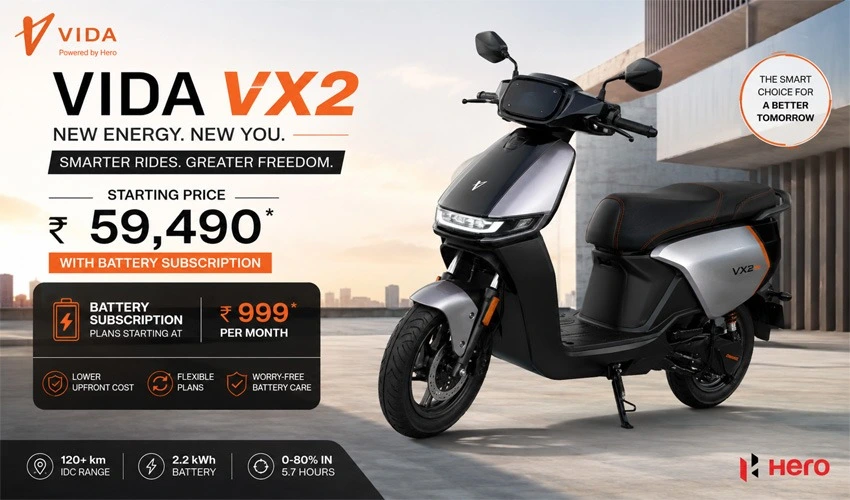
Hero MotoCorp’s Vida VX2 did something few electric scooters in India have attempted: it let buyers separate the cost of the scooter from the cost of the battery. Through its Battery-as-a-Service (BaaS) program, the VX2 can be picked up for a fraction of its outright price, with the battery paid off gradually through a usage-linked monthly plan. For a segment where the battery pack is often 30–40% of a scooter’s total cost, that’s a meaningful shift in how affordable an EV can look on day one.
This article breaks down the VX2’s variants, its outright and BaaS pricing, exactly how the subscription plans work, and who each option actually makes sense for.
The VX2 Lineup: Go, Plus, and Plus 4.4 kWh
The Vida VX2 is sold in three broad configurations, differentiated mainly by battery size and performance:
VX2 Go — the entry model, built around a 2.2 kWh removable battery pack with a claimed IDC range of about 92 km. It’s also offered with the larger 3.4 kWh pack borrowed from the Plus variant, extending claimed range to roughly 142 km. The Go carries a 6 kW PMSM motor tuned for a 70 km/h top speed, with 0–40 km/h coming up in a claimed 4.2 seconds.
VX2 Plus (3.4 kWh) — the original higher-spec variant, using two removable batteries in a 3.4 kWh configuration for a claimed IDC range of roughly 142–146 km. It gets a quicker 3.1-second 0–40 km/h time and a higher top speed than the Go.
VX2 Plus (4.4 kWh) — the newest and most capable variant, introduced in mid-2026. It combines two 2.2 kWh removable batteries into a 4.4 kWh pack, pushing claimed IDC range up to about 187 km. This version also gets a higher claimed top speed of 90 km/h in Sport mode (with Eco capped around 45 km/h and Ride around 70 km/h), plus a Boost function for quicker overtaking. All variants share the same 6 kW, 26 Nm motor architecture, just tuned differently.
Across the range, the VX2 features a 4.3-inch display (LCD on the base Go, TFT on the Plus), turn-by-turn navigation, smartphone connectivity with remote immobilisation, FOTA (firmware-over-the-air) updates, and access to Vida’s public fast-charging network. Fast charging can take a battery from 0–80% in roughly 1–2 hours depending on the charger and pack size, while a full home charge typically takes between 3.5 and 6 hours.
Outright (Full-Payment) Pricing
If you choose to buy the VX2 outright — paying for the scooter and its battery together, with no subscription attached — ex-showroom pricing has looked roughly like this:
- VX2 Go: around ₹84,990–₹99,490 ex-showroom, depending on battery size and ongoing offers
- VX2 Plus (3.4 kWh): around ₹99,490–₹1.10 lakh ex-showroom
- VX2 Plus (4.4 kWh): around ₹1.14 lakh–₹1.44 lakh ex-showroom, reflecting the larger battery and higher performance
On-road pricing will run higher once RTO charges, insurance, and registration are added — in Delhi, the on-road figure for a VX2 has been reported in the ₹1.02 lakh region for mid-spec configurations. These numbers move around fairly often due to introductory offers, so it’s worth confirming the current figure with your local Vida dealership before budgeting.
Battery-as-a-Service (BaaS): How It Actually Works
This is where the VX2 gets genuinely different from most other electric scooters on sale in India. Under BaaS, you pay the (much lower) upfront price for the scooter’s chassis, and then pay for the battery separately, through a monthly plan tied to how much you expect to ride.
Reported BaaS entry prices have included:
- VX2 Go: starting around ₹44,990–₹59,490 with BaaS
- VX2 Plus: starting around ₹57,990–₹64,990 with BaaS
An important clarification, and one that’s easy to miss: despite the name “Battery-as-a-Service,” Hero has structured this as a financing arrangement, not a leasing or subscription service that separates ownership. From the moment of purchase, the customer owns the entire vehicle — chassis and battery — outright. The vehicle is simply hypothecated to the financing partner (Hero FinCorp or Vidyuttech Services Pvt Ltd) until the battery payment plan concludes. This is a meaningful difference from something like the Honda Activa e’s battery model, where the battery itself remains company property throughout. It also means VX2 BaaS buyers remain eligible for applicable government EV incentives, since they hold full ownership from day one.
VX2 Go BaaS Plans
The Go variant has offered two BaaS tenure options:
- 3-year plan: minimum 1,200 km/month usage, priced around ₹1,488/month, at approximately ₹1.24/km
- 5-year plan: lower minimum usage of roughly 750 km/month, priced lower monthly, at a higher per-km rate of around ₹1.47/km
VX2 Plus BaaS Plans
The Plus variant offers more flexibility, with three tenure options:
- 2-year plan: 2,400 km/month minimum, around ₹2,160/month, at approximately ₹0.90/km — the lowest per-km rate in the lineup, best suited to high-mileage riders
- 3-year plan: 1,600 km/month minimum, around ₹1,584/month, at approximately ₹0.99/km — a balanced option for regular daily commuters
- 5-year plan: 800 km/month minimum, around ₹1,128/month, at approximately ₹1.41/km — lower monthly outgo, aimed at lighter urban riders
Across all plans, a one-time fee of roughly ₹1,199 covers stamp duty and documentation. If your actual monthly distance exceeds the plan’s minimum, the extra kilometres are billed at the same per-km rate as your chosen plan, typically adjusted quarterly.
Vida has also sweetened BaaS ownership with a few extras: free charging across its public fast-charging network for the plan’s duration, an extended battery and component warranty, and a commitment to replace the battery free of cost if its health drops below 70% during the plan tenure. Some BaaS customers also get access to an optional, paid buyback program offering up to 67% of the scooter’s stated retail price at the end of the term, though this is limited to select cities.
Running Cost: Is BaaS Actually Cheaper Than Petrol?
The appeal of BaaS becomes clearer with a simple comparison. Take a rider covering around 25 km a day on a VX2 Go under its BaaS plan. Compared against a petrol scooter like the Honda Activa 110 — assuming roughly 45 km/l fuel efficiency and petrol priced around ₹100/litre — the petrol scooter’s fuel cost alone runs meaningfully higher per month than the VX2 Go’s BaaS instalment, before even counting the ₹20,000+ higher upfront cost of the petrol scooter itself.
That said, it’s worth doing the full math for your own usage pattern before assuming BaaS is automatically the cheaper route. Add up the total BaaS payments over the full plan tenure (monthly fee × number of months, plus the one-time documentation charge) and compare that total — plus the scooter’s upfront chassis price — against simply buying the same variant outright with the battery included. In several published cost breakdowns, the total cost of ownership over the full BaaS term ends up somewhat higher than paying outright, which makes sense: you’re essentially financing the battery, and financing has a cost. BaaS is best understood as a way to reduce the size of your initial cash outlay and spread it over time, not necessarily as the cheapest possible way to own the scooter.
Who Should Choose BaaS vs. Outright Purchase
BaaS makes the most sense if:
- Your upfront budget is tight and a ₹99,000+ outright price is a stretch, but a ₹45,000–65,000 entry price is manageable
- You have a fairly predictable daily riding distance and can pick a plan tenure that matches it without frequently exceeding the kilometre cap
- You’re comfortable with the vehicle being hypothecated to a financier for the plan duration, similar to any other vehicle loan
Outright purchase makes more sense if:
- You can comfortably afford the full ex-showroom price and want to avoid the total cost creep that comes with financing
- Your annual mileage is unpredictable or seasonal, making a fixed monthly kilometre plan awkward
- You want to sell or transfer the scooter freely without dealing with an active financing hypothecation — note that BaaS plans are non-transferable, so a subsequent buyer can’t take over your remaining balance
A Few Practical Notes Before You Buy
Owner feedback on the VX2 has been mixed on some fronts — reported issues include occasional battery drain concerns, uneven service centre responsiveness in certain cities, and a still-expanding Vida service network compared to more established brands. Since BaaS involves an active financing relationship, it’s worth reading the loan documentation carefully, understanding the overage charges for exceeding your monthly kilometre cap, and confirming what happens to the extended warranty and free-charging benefits if you choose to foreclose the plan early.
Given how frequently Hero has adjusted VX2 pricing — introductory offers have moved the starting BaaS price around by tens of thousands of rupees within the space of a year — the smartest move is to check current ex-showroom and BaaS pricing directly with your nearest Vida dealership or the official Vida website before finalising your decision, and to ask specifically whether your city currently has active introductory offers running.
Conclusion
The Hero Vida VX2 is one of the more interesting pricing experiments in India’s electric scooter market right now. Its BaaS program genuinely lowers the barrier to entry for buyers who’d otherwise be priced out of a well-specced electric scooter, while still preserving full ownership of the vehicle from day one — a meaningful difference from battery-swap models where the pack never becomes yours. Whether BaaS or outright purchase works out cheaper depends entirely on your riding pattern, so it’s worth running the numbers for your own daily distance before choosing between the two.
Note: Hero Vida has revised VX2 pricing and BaaS plan terms multiple times since launch, and current offers vary by city. Always confirm the latest ex-showroom price, BaaS plan details, and applicable government incentives with your local Vida dealership before purchase.