








Cybersecurity has become one of the most sought-after career paths for students finishing their 12th grade in 2026. As banks, hospitals, government portals, e-commerce platforms, and even small businesses shift entirely online, the demand for professionals who can protect that digital infrastructure keeps climbing. India alone is projected to need well over a million skilled cybersecurity professionals in the coming years, and that gap between demand and available talent is exactly what makes this field so lucrative for someone starting out today.
The good news for 12th-pass students is that cybersecurity isn’t a narrow, single-path career. It’s an entire ecosystem of roles — SOC analysis, penetration testing, cloud security, digital forensics, governance and compliance — and there are multiple course routes to get in, whether you come from a Science, Commerce, or Arts background. This guide walks through the best courses after 12th, what each one actually prepares you for, and how to combine education with certifications to build a genuinely high-paying career.
Why Cybersecurity Is a Smart Choice After 12th
Before picking a course, it helps to understand why this field is worth the investment. Cybersecurity salaries tend to run higher than general IT roles at the same experience level, largely because the skill gap is so wide and the consequences of a security failure are so costly for organizations. Entry-level professionals in India typically start in the ₹3–8 LPA range, and with the right certifications and specialization, experienced professionals in roles like penetration testers, cloud security engineers, or security architects can earn well into double digits, with senior leaders such as CISOs commanding significantly more. Unlike many tech roles, cybersecurity is also difficult to automate away, since it fundamentally requires human judgment to interpret ambiguous threats — which adds a layer of long-term job security.
1. B.Tech in Cyber Security
For students with a Science background (Physics, Chemistry, Mathematics in 12th), a B.Tech in Cyber Security is the most comprehensive option. This four-year degree covers networking fundamentals, cryptography, security audits, ethical hacking, and information security management in depth, and it’s usually the strongest foundation for students who want to eventually move into specialized or leadership roles.
Admission is generally through entrance exams like JEE Main, state-level tests, or university-specific exams, and fees vary widely — government institutes are far more affordable but highly competitive, while private universities charge more but often provide better lab access and placement support. Career paths after this degree include network security engineer, information security analyst, ethical hacker, and cybersecurity consultant.
2. B.Tech in Computer Science with a Cyber Security Specialization
If you’re not sure you want to commit entirely to security from day one, a general Computer Science degree with a cybersecurity specialization track offers more flexibility. You get the same broad CS foundation — programming, data structures, operating systems, databases — while still building specialized security knowledge in the later years. This route is particularly useful if your interests might shift toward software engineering, AI, or data science later, since the core CS skills transfer easily across all of these fields.
3. BCA with Cyber Security Specialization
For Commerce and Arts students, or anyone who wants a shorter and more affordable degree than a B.Tech, a Bachelor of Computer Applications (BCA) with a cybersecurity specialization is an excellent middle ground. It’s a three-year program that covers programming, networking, databases, and web development alongside foundational security concepts. Many working cybersecurity professionals in India actually come from BCA backgrounds, and it pairs particularly well with an MCA or industry certifications afterward. It’s widely available, generally more affordable than engineering programs, and gives non-Science students a credible way into the field.
4. BSc in Cyber Security or Information Security
A BSc in Cyber Security is a three-year science degree that leans more academic and research-oriented compared to a B.Tech, though it still covers core technical ground like network security, cryptography, and digital forensics. This is a good option for students who want a strong theoretical grounding and are considering further studies like an MSc in Digital Forensics or a research-driven career later on.
5. Diploma in Cyber Security
For students who want to enter the workforce faster without committing to a three or four-year degree, diploma programs are a practical option. These typically run for one to two years, cost significantly less than a full degree, and focus heavily on job-ready skills like networking, ethical hacking fundamentals, and security tool usage. Many diploma programs also build in preparation for globally recognized entry-level certifications. The trade-off is that a diploma alone can limit long-term career growth and higher-level opportunities compared to a full degree, so it works best when paired with continuous certification and hands-on project work.
6. Certificate Courses in Ethical Hacking and Cyber Security
Short-term certificate courses — sometimes just a few weeks to a few months — are ideal for students who want to test the waters before committing to a longer program, or who want to add a specific skill on top of an existing degree. These are widely offered by private training institutes and increasingly by government-backed platforms as well. On their own, they’re rarely enough to land a strong job, but combined with a degree, they meaningfully boost employability.
7. Government-Backed and Free Learning Platforms
Budget-conscious students shouldn’t overlook government-backed platforms like NPTEL (through SWAYAM), which offers free courses developed by IITs and IISc with an optional low-cost certification exam. These are excellent for building foundational credibility and demonstrating self-motivated learning to future employers, especially before or alongside a formal degree.
Certifications That Matter Alongside Any Course
Regardless of which degree or diploma path you choose, industry certifications play an outsized role in cybersecurity hiring — often more than the specific name of your degree. Some of the most valuable certifications to target at different career stages include:
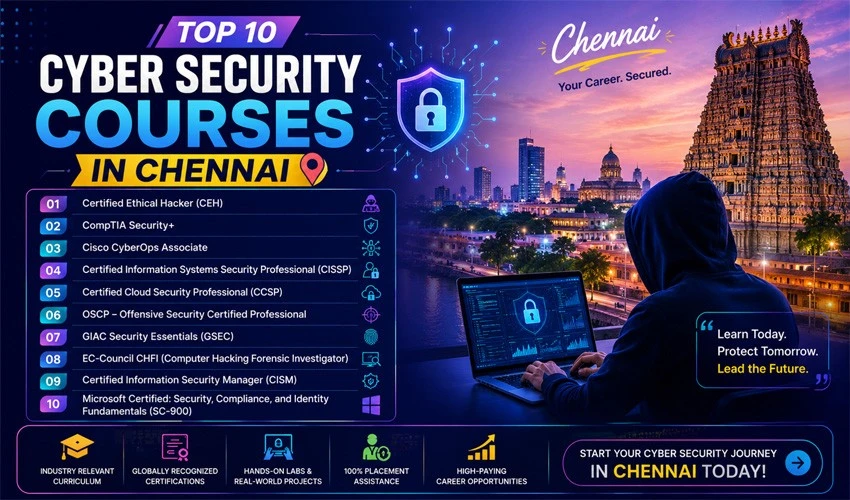
- CompTIA Security+ – a strong entry-level certification covering security fundamentals
- Certified Ethical Hacker (CEH) – widely recognized for penetration testing and ethical hacking roles
- CompTIA CySA+ – useful for SOC analyst and defensive security roles
- eJPT or OSCP – for students aiming specifically at penetration testing careers
- AWS or Azure Security certifications – essential as more infrastructure moves to the cloud
- CHFI (Computer Hacking Forensic Investigator) – for students interested in digital forensics
- CISSP or ISO 27001 Lead Auditor – valuable later in your career for governance, risk, and compliance (GRC) roles
Building Practical Skills Alongside Your Course
Cybersecurity is one of the few fields where practical, demonstrable skill can matter as much as your degree. While you’re studying, it’s worth getting hands-on with tools like Nmap for network scanning, Wireshark for packet analysis, Metasploit and Burp Suite for penetration testing practice, and Kali Linux as your primary testing environment. Participating in Capture the Flag (CTF) competitions, maintaining a home lab, and documenting projects on GitHub all give you tangible proof of ability — something recruiters increasingly look for over a transcript alone.
Choosing the Right Path for You
If you’re a Science student aiming for the most comprehensive, long-term foundation, a B.Tech in Cyber Security or Computer Science with a security specialization is the strongest starting point. If you’re from a Commerce or Arts background, or want a shorter and more affordable route, a BCA with cybersecurity specialization or a diploma program makes more sense. If budget or time is tight, starting with a certificate course or free government-backed platform while building projects on the side can still get you noticed by employers, especially at smaller firms and startups that increasingly hire on demonstrated skill rather than degree pedigree alone.
Whichever path you pick, the real differentiator over the next few years won’t just be your qualification — it will be how consistently you keep learning, since cybersecurity threats and defensive techniques evolve constantly, and employers value professionals who visibly keep pace with that change.
Final Thoughts
Cybersecurity after 12th offers one of the clearest routes to a high-paying, future-proof career in India’s fast-digitizing economy. Whether you choose a full engineering degree, a flexible BCA program, or a faster diploma route, what ultimately determines your earning potential is the combination of solid fundamentals, relevant certifications, and real hands-on project experience. Start early, stay consistent, and treat every certification and project as a building block toward the specialization — SOC, penetration testing, cloud security, or GRC — that fits your interests best.