







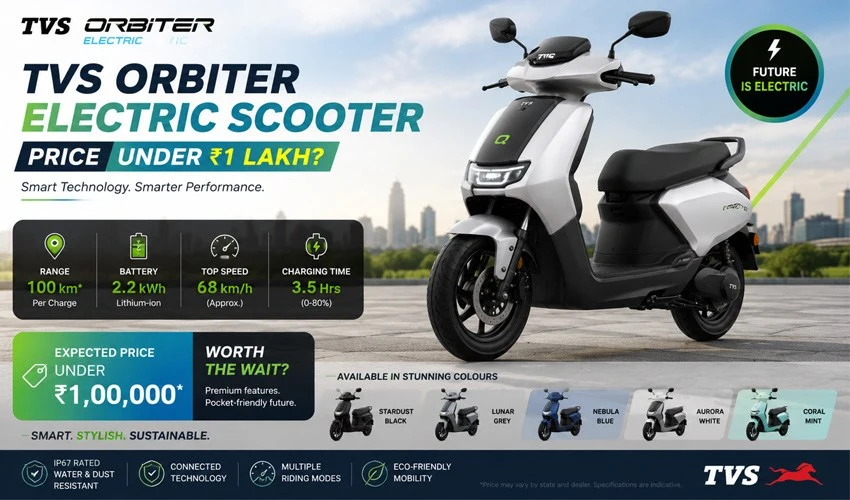
The electric scooter market in India has quietly turned into one of the most competitive corners of the two-wheeler industry, and TVS Motor Company has thrown its hat into the budget-friendly ring with the Orbiter. Positioned below the more premium iQube range, the Orbiter was built with a clear brief: give first-time EV buyers a scooter that doesn’t punish their wallets while still feeling modern, practical, and dependable. So, does the TVS Orbiter actually deliver an electric scooter under ₹1 lakh? Let’s break down the pricing, variants, and what you actually get for your money.
TVS Orbiter Price Overview
The TVS Orbiter was launched in August 2025 at an introductory ex-showroom price of ₹99,900 in Bengaluru, inclusive of applicable subsidies. That single number made headlines because it slotted the Orbiter comfortably under the psychological ₹1 lakh mark, undercutting several rivals in the same segment.
Since launch, TVS has expanded the lineup, and pricing today varies depending on the city, variant, and whether you opt for the standard purchase or the Battery-as-a-Service (BaaS) model. Broadly speaking, ex-showroom prices for the Orbiter range from around ₹88,000 on the lower end to roughly ₹1.05–1.15 lakh for the top variant, depending on the source and city of purchase. On-road prices, once insurance and other charges are factored in, typically land between ₹98,000 and ₹1.17 lakh.
So yes — for buyers who pick the entry-level variant or opt into the BaaS subscription route, the TVS Orbiter can be had well under ₹1 lakh. The top-spec variant, however, can nudge past that mark once you add insurance and registration costs, especially outside subsidy-friendly states.
Two Variants: V1 and V2
TVS structured the Orbiter lineup around two clear variants, each targeting a slightly different type of rider.
Orbiter V1 is the newer, more affordable addition to the family, introduced in March 2026. It comes with a smaller 1.8 kWh battery pack that delivers a claimed range of 86 km on a full charge and can juice up from 0-80% in around 2 hours and 20 minutes — noticeably quicker than the bigger variant. The V1’s ex-showroom price (without the subscription plan) sits around ₹84,500 in Delhi, but the real headline is the BaaS option, which brings the upfront cost down to just ₹49,999. Under this arrangement, buyers pay a lower purchase price for the scooter itself and then pay a separate monthly subscription for the battery, which also comes bundled with an extended warranty of up to five years or 70,000 km.
Orbiter V2 is the original, higher-range variant that debuted at launch. It packs a larger 3.1 kWh battery pack with a claimed IDC range of 158 km — nearly double that of the V1 — though charging from 0-80% takes longer, at approximately 4 hours and 10 minutes. This variant is priced closer to, and sometimes just above, the ₹1 lakh mark depending on your city and any ongoing offers.
In short, if range anxiety worries you and you do longer daily commutes, the V2 makes more sense. If you’re a shorter-distance city rider who values a lower upfront cost and quicker charging, the V1 — especially with BaaS — is the more budget-conscious pick.
The Battery-as-a-Service (BaaS) Angle
One of the more interesting moves TVS has made with the Orbiter is rolling out the BaaS model across its electric scooter range, including the iQube series. The logic here is simple: batteries are the single most expensive component in any electric vehicle, often accounting for a large chunk of the total price. By decoupling the battery cost from the vehicle price and converting it into a monthly subscription, TVS effectively lowers the barrier to entry for buyers who are hesitant about the higher upfront cost typically associated with EVs.
For someone eyeing the Orbiter V1, this means walking into a dealership and riding out on a scooter for under ₹50,000, with the remaining battery cost spread out over a subscription term. TVS states that eligibility requires being at least 18 years old, holding a valid driving licence, and clearing a basic credit assessment, since the plan works similarly to a financed purchase.
Compared to a straightforward one-time purchase, the BaaS model shifts your electric scooter from being a capital expense to more of an operating expense — you know your monthly outgo in advance, you get unlimited kilometres with no restrictive caps, and the extended battery warranty is bundled in as a mandatory (non-optional) part of the deal. TVS has indicated that over a typical ownership period, BaaS buyers could save a meaningful amount compared to standard EV ownership, and considerably more when compared against the running costs of an equivalent petrol scooter.
What You Get for the Price: Features and Design
Where the Orbiter really tries to earn its keep is in how much practicality TVS has packed into a budget electric scooter. This isn’t a stripped-down, bare-bones commuter — it comes loaded with features that were, until recently, reserved for costlier EVs.
- Storage: A genuinely large 34-litre under-seat boot that can comfortably swallow two full-face helmets, addressing one of the most common complaints riders have about compact scooters.
- Wheels and stability: A 14-inch front wheel — a segment-first at this price point — paired with a 12-inch rear wheel, offering better stability and grip over uneven city roads compared to the smaller wheels typically found on rivals.
- Comfort: An 845 mm long, well-cushioned flat seat and a generous 290 mm straight-line footboard that gives taller riders enough room to stretch out, along with a low seat height that makes the scooter accessible to shorter riders too.
- Braking: A combination braking system pairing a front disc brake with a rear drum, tuned for balanced, predictable stopping power.
- Tech: A Bluetooth-connected colour LCD instrument cluster displaying speed, battery level, remaining range, and turn-by-turn navigation. The scooter also connects to TVS’s SmartXonnect app, enabling real-time location tracking, geo-fencing, and over-the-air software updates.
- Rider-assist features: Cruise control that works even at lower speeds, hill-hold assist to prevent rollback on inclines, and a dedicated parking assist mode for easier low-speed manoeuvring — features that are genuinely rare to find in this price bracket.
- Build: An IP67-rated powertrain, meaning the scooter is designed to handle water splashes and sudden downpours without drama, which matters a lot given how unpredictable Indian monsoons can be.
- Riding modes: Eco and City modes let riders balance range against performance depending on the day’s needs.
Design-wise, the Orbiter takes a departure from TVS’s boxier iQube styling, opting instead for a slimmer, more aerodynamic silhouette with a distinctly utilitarian, almost no-nonsense look that borrows visual cues from practical two-wheelers common in other Asian markets. It’s available in six dual-tone colour options — Neon Sunburst, Stratos Blue, Lunar Grey, Stellar Silver, Cosmic Titanium, and Martian Copper — giving buyers a reasonable amount of visual choice for a scooter in this segment.
Performance and Real-World Usability
The Orbiter uses a hub-mounted BLDC motor and tops out at a claimed 68 km/h, which is adequate for city commuting but not something you’d call quick or thrilling. Riders who’ve spent time with the scooter generally describe the performance as mellow, particularly in Eco mode, and note that the scooter needs to be run in City mode with more throttle input if your commute involves steep flyovers or hilly stretches. At around 101 kg, the Orbiter is reasonably light for its category, which helps with low-speed manoeuvring and parking in tight urban spaces.
This isn’t a performance-focused electric scooter, and TVS doesn’t pretend otherwise. Its entire value proposition rests on maximising range and practicality rather than outright speed, making it best suited to daily office commutes, errands, and college runs rather than long highway stretches or hilly terrain.
How It Stacks Up Against the Competition
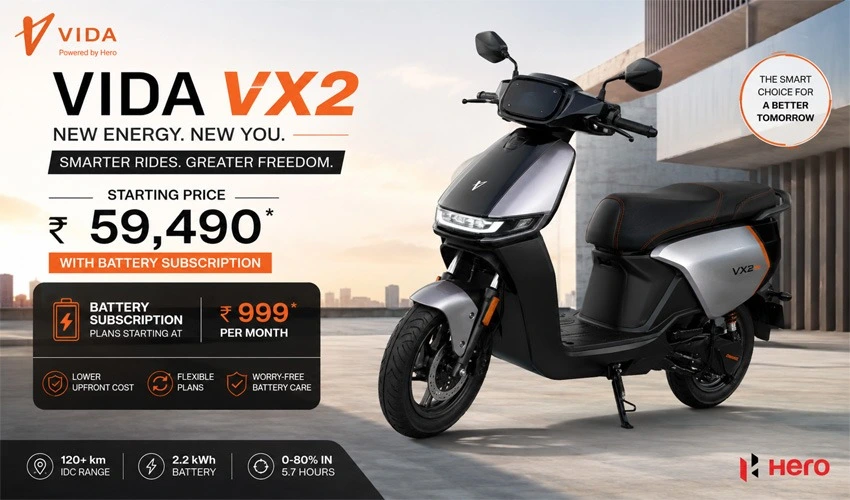
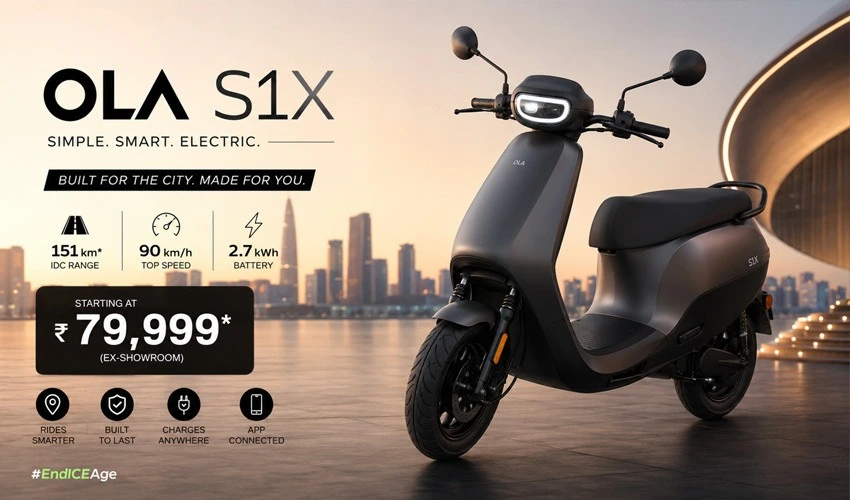
The Orbiter enters a crowded and increasingly aggressive segment, going up against the likes of the Ola S1 X, Ather Rizta, and Hero Vida VX2 — all of which compete on similar ground of affordability, range, and features. What sets the Orbiter apart is its combination of a genuinely large storage compartment, a bigger front wheel for stability, and driver-assist features like cruise control and hill-hold, none of which are guaranteed across every rival at this price. On the flip side, buyers considering the top-spec 3.1 kWh variant should be mindful that its price can creep past the ₹1 lakh mark depending on the city and applicable charges, so it’s worth comparing on-road pricing carefully before booking.
Final Verdict: Is the TVS Orbiter Worth It Under ₹1 Lakh?
If your priority is a simple, reliable, feature-rich electric scooter for daily city commuting, and you’re not chasing outright performance, the TVS Orbiter makes a strong case for itself — especially the V1 variant paired with the BaaS scheme, which can genuinely get you on the road for under ₹50,000 upfront. Even the standard purchase route keeps the Orbiter largely within or very close to the ₹1 lakh bracket, making it one of the more accessible electric scooters from an established, trusted manufacturer.
For buyers who want more range and don’t mind stretching the budget slightly, the V2 variant with its 158 km claimed range is the more sensible long-term pick. Either way, TVS has positioned the Orbiter as a genuinely no-nonsense, practical entry point into electric mobility — and for a lot of first-time EV buyers, that’s exactly what they’re looking for.
Note: Prices mentioned are ex-showroom/on-road figures reported at the time of writing and may vary by city, ongoing offers, state subsidies, and dealership. Always confirm current pricing with your nearest TVS dealership or the official TVS Motor website before making a purchase decision.