







If your budget is closer to ₹25,000–30,000 than ₹50,000, you’re shopping in India’s true entry-level electric scooter segment. This is the price band aimed at short, local trips — the walk to the vegetable market, the school run, the quick hop to a friend’s place — rather than long daily commutes. Expectations need to be set correctly here: at this price, you’re mostly looking at lead-acid batteries, modest 25 km/h top speeds, and 40–60 km of range rather than the lithium-ion, 60-plus-km scooters found in the ₹40,000–50,000 bracket.
That said, this segment has a real purpose. It’s licence-free, registration-free, insurance-free (for low-speed models under 25 km/h), and dramatically cheaper to run than a petrol scooter or even a fuel-guzzling bike. For students, retirees, homemakers, and anyone whose daily distance is genuinely short, a sub-₹30,000 electric scooter can be a smart, low-commitment way to go electric.
This article breaks down what to expect, what to watch out for, and ten of the most talked-about options currently available under ₹30,000.
What ₹30,000 Actually Buys You
Before diving into the list, it helps to understand the trade-offs baked into this price point.
Lead-acid batteries are the norm, not the exception. Unlike the ₹40,000+ segment where lithium-ion is increasingly standard, most scooters under ₹30,000 still use lead-acid battery packs. These are heavier, have a shorter usable life (roughly 300–500 charge cycles, or about 1.5–2 years of regular use), and lose range noticeably as they age. On the plus side, they’re cheaper to replace when the time comes, and replacements are widely available even in smaller towns.
Top speed is capped around 25 km/h. This is intentional — it’s what keeps these scooters in the licence-free, registration-free category under Indian motor vehicle rules. It also means they’re not built for highway stretches or fast arterial roads; they’re designed for slow, congested city lanes and residential streets.
Range claims are optimistic. A “60 km range” claim on a lead-acid scooter in this bracket usually assumes flat roads, a single light rider, and ideal battery health. In daily use — especially with some inclines, a heavier rider, or after a year of battery wear — expect the real figure to land noticeably lower.
Features are minimal by design. Don’t expect a digital dashboard with navigation, regenerative braking, or app connectivity at this price. Most models offer a simple analogue or basic digital speedometer, a USB charging port at best, and manual indicators and horn — functional, not flashy.
Government subsidy eligibility is limited. The PM E-DRIVE scheme’s demand incentive of ₹2,500 per kWh (capped at ₹5,000 per vehicle) only applies to scooters using advanced battery chemistry — lithium-ion, LFP, or NMC. Since most sub-₹30,000 models run on lead-acid batteries, many of them simply don’t qualify for this subsidy. If getting the subsidy matters to you, check the battery type and confirm eligibility with the dealer before assuming a discount applies.
None of this makes the segment a bad choice — it just means you should buy with realistic expectations rather than comparing spec sheets against a ₹50,000 scooter.
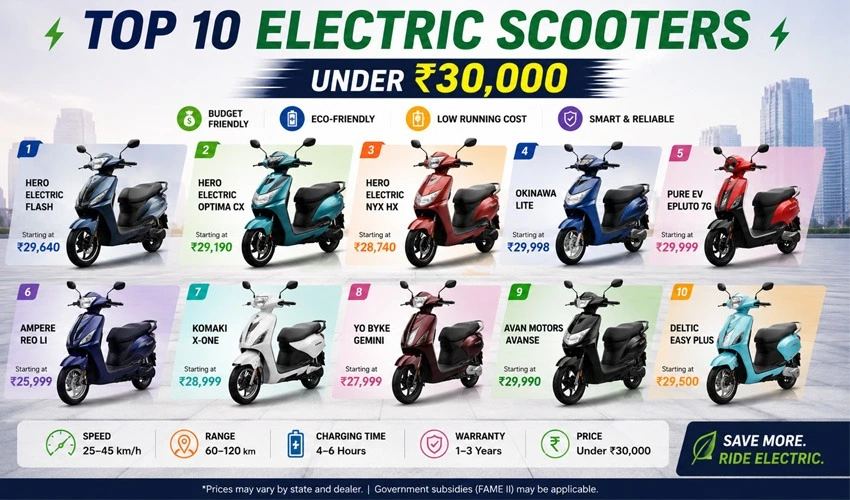
Top 10 Electric Scooters Under ₹30,000
Prices below are approximate ex-showroom figures for base variants and can shift by city, dealer offers, and battery type selected. Always confirm current on-road pricing locally before buying.
1. Avon E Plus (around ₹25,000) One of the most frequently recommended scooters in this bracket, the E Plus is built around simplicity — an easy-to-ride frame, straightforward controls, and dependable mileage for short trips. It’s a common first choice for buyers who just want an inexpensive way to get around the neighbourhood.
2. Avon E Lite (around ₹28,000) A step up from the E Plus within the same brand family, the E Lite adds a bit more polish in styling and ride comfort while staying comfortably under ₹30,000. Worth comparing directly against the E Plus if you can stretch your budget slightly.
3. Green EV Sunny (around ₹25,000–26,500) A compact, city-focused scooter with a claimed range in the 40–60 km band depending on load and terrain. It’s a popular pick for buyers prioritising a low upfront cost above everything else.
4. Green EV Udaan (around ₹22,000–24,500) One of the cheapest genuine electric scooters available in India right now, the Udaan strips things down to the essentials. It suits very short, flat commutes where minimal range is genuinely sufficient — think a few kilometres each way, not a daily 15 km round trip.
5. Komaki XR1 (around ₹29,999) Sitting right at the top of this price bracket, the XR1 packs in slightly more features and a sturdier build than some of the cheaper alternatives on this list, making it a reasonable option if you want to spend right up to the ₹30,000 ceiling for a bit of extra durability.
6. Komaki Super (around ₹29,500) Another Komaki entry aimed at riders who want a recognisable brand name with wider service availability, since Komaki has built out a reasonably large dealer network across smaller Indian cities and towns.
7. Sazio Electric Scooty (around ₹25,000) A straightforward, no-nonsense budget option built for riders who mainly need basic point-to-point transport without added frills. It’s often positioned toward first-time EV buyers testing the waters before committing to a pricier model later.
8. Raiden Electric Scooter (around ₹30,000) Right at the ceiling of this list, the Raiden offers slightly sportier styling compared to some of its plainer-looking rivals, appealing to younger riders who still want to stay within a tight budget.
9. Sheldon Scooter (around ₹30,000) Another option at the very top of the ₹30,000 bracket, the Sheldon focuses on a comfortable riding posture and a wider seat, which some riders find preferable for slightly longer in-city trips despite the modest top speed.
10. Ujaas eZy (around ₹30,000–32,000, often discounted closer to ₹30,000) Powered by a lightweight 48V battery setup, the Ujaas eZy is designed specifically for short daily errands. It occasionally lists just above ₹30,000 at full price but is frequently available at or under that mark through dealer offers, so it’s worth checking current local pricing.
How to Choose Between Them
With ten fairly similar-looking options, the deciding factors usually come down to four things:
- Your actual daily distance. If you’re travelling under 10 km a day round trip, almost any scooter on this list will do the job. If you’re closer to 15–20 km daily, lean toward models with the higher end of the claimed range, and mentally discount that figure by 15–20% for real-world conditions.
- Local service support. Ask around locally (or check online reviews specific to your city) about which of these brands has an actual service centre or authorised mechanic nearby. A scooter that’s ₹2,000 cheaper isn’t worth it if you have to travel across town every time the battery needs attention.
- Battery replacement cost and availability. Since lead-acid batteries in this segment typically need replacing every 1.5–2 years, ask the dealer upfront what a replacement pack costs and whether it’s readily stocked. This ongoing cost matters more than the sticker price over a 3-year ownership period.
- Test ride before you commit. Seat height, handlebar reach, and ride comfort vary more than the spec sheets suggest. A five-minute test ride will tell you more than any brochure about whether a scooter actually suits your build and riding style.
Is a Sub-₹30,000 Electric Scooter Right for You?
This segment makes the most sense for a specific kind of buyer: someone whose trips are short and predictable, who values low upfront cost over range or features, and who’s comfortable with the idea of a lead-acid battery replacement every couple of years as a routine maintenance cost — much like replacing tyres or brake pads on a petrol scooter.
If your daily commute regularly exceeds 15–20 km, or if you frequently ride with a pillion, it’s worth stretching your budget toward the ₹40,000–50,000 bracket instead, where lithium-ion batteries and better build quality start to become standard. But for genuinely short, local use, the scooters on this list deliver real savings over petrol without demanding a licence, registration, or insurance — making them one of the lowest-friction ways to try electric mobility in India today.
Note: Prices, specifications, and availability for budget electric scooters change frequently and vary by city and dealer. Confirm current pricing, battery type, and warranty terms directly with the dealership before purchase.