








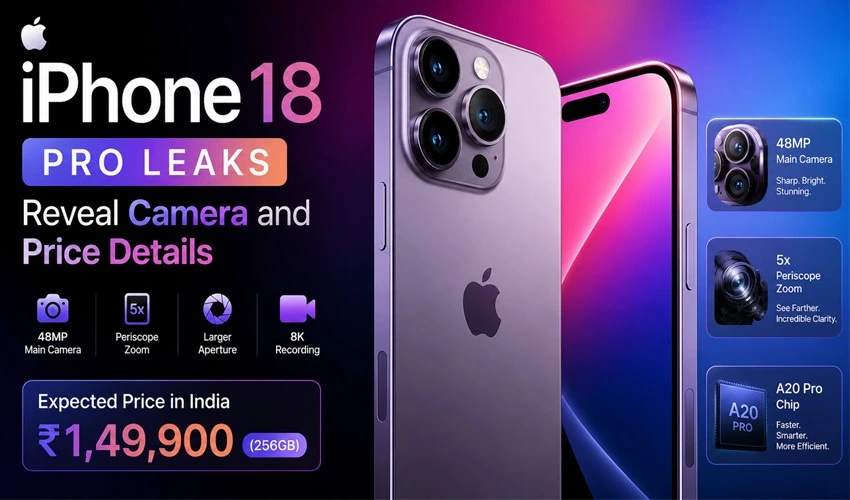
Apple’s iPhone 18 Pro is still months away from an official announcement, but the leak pipeline has been unusually active in recent weeks. Between supply chain reports, design model leakers, and a wave of documents tied to a third-party data breach, a fairly detailed picture of Apple’s next Pro-tier iPhone has started to emerge — particularly around two things buyers care about most: the camera system and the price tag. Here’s a breakdown of everything currently rumored about the iPhone 18 Pro, and what it could mean if you’re planning to upgrade this fall.
Disclaimer: Apple has not confirmed any of the details below. Everything in this article is based on leaks, supply chain reports, and industry analysis, and specifications or pricing may change — or not materialize at all — once Apple makes an official announcement.
Launch Timeline: What to Expect
Multiple reports agree that the iPhone 18 Pro and iPhone 18 Pro Max will launch on Apple’s traditional September schedule, likely with an announcement event around September 8 or 9, 2026, pre-orders opening a few days later around September 11, and devices shipping around September 18.
What’s changing this cycle is the rest of the lineup. Rather than launching four models together in the fall as usual, Apple is reportedly shifting the standard iPhone 18 and a more affordable iPhone 18e to a spring 2027 release window. That would leave the Pro and Pro Max as the only new iPhones launching this September — alongside Apple’s long-rumored first foldable device, sometimes referred to in leaks as the “iPhone Fold” or “iPhone Ultra.” For buyers who typically wait for the standard iPhone rather than paying Pro prices, this reported schedule split means a longer wait than usual.
The Big Camera Upgrade: Variable Aperture Lens
The most talked-about leak surrounding the iPhone 18 Pro centers on its rear camera system — specifically, the introduction of a mechanical variable aperture lens on the main sensor. This would be a genuinely new capability for the iPhone Pro lineup, and one that’s more commonly associated with dedicated cameras than smartphones.
A variable aperture allows the camera to physically adjust how much light reaches the sensor, rather than relying entirely on software processing to simulate depth-of-field or manage exposure. In practical terms, that means better low-light performance, more natural background blur in portrait-style shots, and finer control over exposure across a much wider range of lighting conditions — from bright outdoor scenes to dim indoor environments — without leaning as heavily on computational photography tricks.
Leaks suggest this new lens will sit alongside a larger 48-megapixel main sensor, part of what’s being described as one of Apple’s most significant camera hardware upgrades in years. Enhanced telephoto capabilities have also been mentioned, though most of the leaked detail so far centers on the main sensor and its new aperture mechanism rather than a specific telephoto specification.
There’s a real cost behind this upgrade. According to supply chain sourcing, the new moving-optics lens carries a component cost roughly 50% higher than the high-end lens currently used in the iPhone 17 Pro. That’s a substantial jump in Apple’s bill of materials for a single component, and it’s a big part of why pricing speculation around the iPhone 18 Pro has been so active this cycle.
Physical Trade-offs: A Bigger Camera Bump
Fitting the new lens system into the phone isn’t without physical consequences. Leaks point to the rear camera plateau growing by roughly 2mm compared to the iPhone 17 Pro, a change needed to accommodate the moving-parts mechanism required for variable aperture. It’s a modest shift on paper, but one that will be noticeable in hand and could affect how existing cases and accessories fit.
Beyond the camera bump, the rest of the design is expected to stay fairly familiar. Leaked design models suggest Apple is moving away from the two-tone rear glass look used on the iPhone 17 Pro, in favor of a more unified finish where the back glass more closely matches the color of the aluminum frame. The phone is expected to retain an anodized aluminum build, similar to the iPhone 17 Pro, despite some durability complaints about that finish in the current generation.
Color options have also leaked fairly extensively. Reports point to four colors: Silver, Light Blue, Black or Dark Gray, and a new deep reddish shade — described by some sources as “Dark Cherry,” with a slight purple tinge rather than a pure red. Multiple independent leaks, including hands-on looks at early design models, appear to corroborate this color lineup.
Pricing: Where the Leaks Disagree
This is where things get genuinely messy, and it’s worth walking through the timeline of leaks rather than treating any single number as settled.
Early rumors (initial reports): Some of the first pricing leaks this cycle suggested a fairly aggressive price hike of $200–$300 over the iPhone 17 Pro’s starting price, driven largely by rising component costs.
Mid-cycle reports: A separate wave of reporting pointed to the iPhone 18 Pro starting at $1,399 or $1,499, with the Pro Max costing an additional $100–$150 on top of that. These reports tied the increase to broader global shortages of RAM and NAND flash storage — a supply crunch reportedly being driven in part by surging demand from AI hardware manufacturers, which has pushed component costs up across the entire consumer electronics industry, not just for Apple. Some of these reports also suggested Apple could eliminate the base 256GB storage tier entirely, replacing it with a 512GB starting configuration to help justify the higher price.
More recent reporting: The most recent leaks tell a notably different story. According to newer supply chain sourcing, Apple may only raise the iPhone 18 Pro’s price by a modest $50, despite the variable aperture lens costing roughly 50% more to produce than the current camera system. Under this scenario, Apple would reportedly absorb much of the increased component cost — including rising memory prices — rather than passing it fully onto consumers. The stated rationale is competitive: Android flagship makers, including Samsung, have been raising prices on their own high-end phones, and Apple may see an opportunity to hold the line on pricing to pull in customers switching from pricier or aging Android devices.
So which is it — a triple-digit jump or a token $50 increase? At this stage, neither can be ruled out. Leaks this far ahead of a launch often reflect different stages of Apple’s internal planning, and pricing strategy is one of the last things Apple finalizes before an announcement. It’s also entirely possible different regions see different outcomes — a modest increase in the US, for instance, doesn’t necessarily rule out steeper effective increases elsewhere once currency conversion and import duties are factored in.
What does seem consistent across most reports is the underlying pressure: rising RAM and NAND storage costs, driven partly by AI-related demand elsewhere in the tech industry, are squeezing margins across the board — not just for Apple, but for Samsung, Google, Motorola, and other major device makers as well.
Chip and Connectivity Leaks
Camera and pricing aside, the iPhone 18 Pro is also expected to debut Apple’s first 2-nanometer chip, the A20 Pro, reportedly codenamed “Borneo” internally. Leaked documentation — reportedly surfaced through files taken in a breach affecting supply chain partner Tata — suggests Apple may use a new chip packaging approach called WMCM (Wafer-Level Multi-Chip Module), which would separate the CPU, GPU, and Neural Engine onto distinct dies rather than housing them together as in previous designs. This is a more technical leak, but it points to Apple restructuring how its silicon is built at a fairly fundamental level, likely in pursuit of better yields and thermal performance.
On connectivity, reports diverge on modem strategy. Some leaks suggest Apple will expand use of its in-house C2 modem across the iPhone 18 Pro lineup, while other, more recent reporting suggests a region-based split — with Qualcomm modems used in some markets (reportedly including the US) and Apple’s C2 chip used elsewhere. The C2 modem itself is expected to bring improved 5G performance, better power efficiency, and potentially expanded satellite connectivity features.
What This Means for Buyers
If even half of these leaks hold up, the iPhone 18 Pro is shaping up to be one of the more consequential Pro-tier updates in recent memory — not because of a dramatic redesign, but because of a genuinely new camera capability that’s rare in the smartphone space. A variable aperture lens isn’t a spec-sheet bullet point; it’s a functional upgrade that could noticeably change photo quality in mixed and low-light conditions.
The pricing picture is far less settled, and buyers should be cautious about anchoring to any single leaked number this far ahead of launch. What’s worth watching between now and September is whether Apple confirms a storage tier change, whether the price increase lands closer to $50 or closer to $200+, and how regional pricing — especially outside the US — reflects these underlying cost pressures once currency and import factors are added in.
For now, the safest approach is to treat the camera upgrade as the more reliably corroborated leak, and the pricing as still very much in flux until Apple’s September event makes things official.