







Few contests in world sport carry the emotional weight of a match between the Pakistan and India national cricket teams. Born out of a shared cricketing heritage and separated by the trauma of Partition, these two nations have turned a bat-and-ball game into one of the most closely watched, politically charged, and passionately followed rivalries on the planet. This timeline traces the full arc of that rivalry — from its formal beginning in 1952 to the tension-filled matches of the mid-2020s.
The Origins: Partition and the Birth of a Rivalry
The roots of the India-Pakistan cricket rivalry stretch back to 1947, when British India was partitioned into the independent nations of India and Pakistan. That division came at an enormous human cost, with widespread violence and mass migration reshaping the subcontinent almost overnight. Pakistan joined the Imperial Cricket Conference — the forerunner of today’s International Cricket Council — in 1948, and was elevated to full Test-playing status in July 1952. Cricket, a sport both nations had inherited from British colonial rule, quickly became a proxy for national pride and unresolved political tension.
Interestingly, the earliest connection between the two teams predates Pakistan’s official Test debut. A handful of players, including Abdul Hafeez Kardar and Amir Elahi, had represented India internationally before Partition and later went on to play for Pakistan — a reminder that the two teams share a common cricketing bloodline even as their on-field relationship grew fierce.
1952: The First Official Series
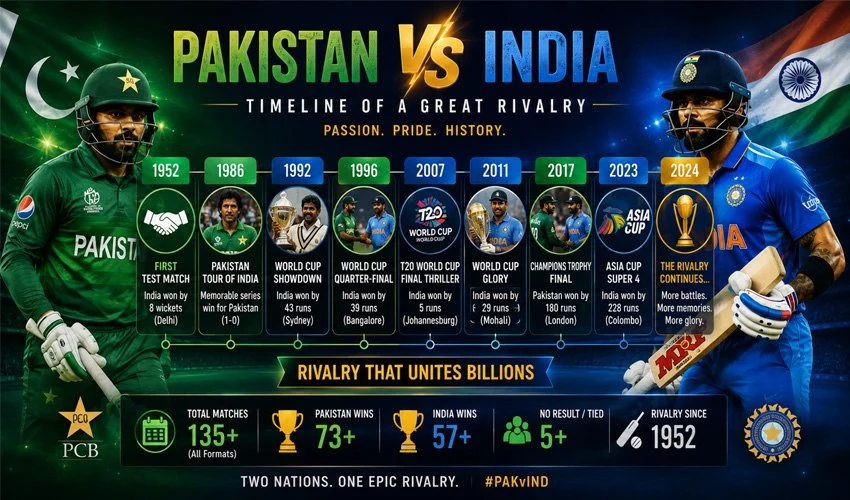
The rivalry formally began in October 1952, when Pakistan toured India to play a five-match Test series — Pakistan’s very first Test assignment as an independent cricketing nation. India won the opening Test in Delhi by an innings and 70 runs, but Pakistan responded almost immediately, winning the second Test in Lucknow by an innings and 43 runs to record their first-ever Test victory. India ultimately won the series 2-1, with the remaining two matches ending in draws. Pakistani pace bowler Fazal Mahmood emerged as an early hero of the fixture, while India’s Vinoo Mankad produced a match-winning bowling performance in the series opener. That 1952 series set the tone: hard-fought cricket, moments of brilliance from both sides, and a contest that mattered far beyond the scoreboard.
The 1950s and 1960s: Cricket Amid Cold Peace
Throughout the 1950s and early 1960s, India and Pakistan continued to play Test series against each other, alternating hosting duties. India’s tour of Pakistan in 1954-55 ended in a series of five drawn Tests, reflecting the cautious, attritional cricket typical of the era. Pakistan, with strong pace and swing bowling, often held an edge in these encounters. However, the political climate was shifting. The Indo-Pakistani War of 1965, followed by the war of 1971, brought cricketing ties to a complete halt. For over a decade and a half, the two teams did not meet on a cricket field at all — a stark illustration of how deeply geopolitics and sport were intertwined.
1978: Resumption After a 17-Year Gap
Cricketing relations resumed in 1978, when India toured Pakistan for the first time in nearly two decades. The timing coincided with a period when leadership in both countries was more distanced from the events of 1971, allowing space for normalization. Pakistan won the Test series convincingly, and the tour also marked a growing shift toward the shorter, One Day International format, which was beginning to reshape international cricket globally. This period introduced a new generation of stars and reestablished bilateral cricket as a regular — if politically sensitive — fixture between the two nations.
The 1980s: Neutral Venues and Growing Spectacle
As One Day Internationals gained popularity through the late 1970s and 1980s, India-Pakistan matches became more frequent and more widely watched. Political sensitivities, however, meant that many contests were shifted to neutral venues, particularly Sharjah in the United Arab Emirates, which became an unofficial second home for India-Pakistan cricket due to the large South Asian expatriate community in the Gulf. This era produced one of the most iconic moments in the rivalry’s history: the 1986 Austral-Asia Cup final in Sharjah, where Pakistan’s Javed Miandad struck a last-ball six off India’s Chetan Sharma to snatch a stunning victory. That single shot became etched into the folklore of the rivalry and remains one of the most replayed moments in South Asian cricket history.
Cricket diplomacy also had its moments during this decade. In 1987, Pakistani President Zia-ul-Haq attended a Test match in India, a gesture widely viewed as an attempt to ease border tensions through sporting goodwill — one of several instances where cricket briefly functioned as an informal diplomatic bridge between the two governments.
The 1990s: World Cup Drama and Pakistani Dominance in Bilateral Cricket
The 1990s elevated the rivalry to a new level of intensity, particularly in ICC events. Pakistan, boasting a formidable pace attack, generally had the upper hand in bilateral ODI series during this decade. However, a pattern also began to emerge that would define the rivalry for decades to come: India’s dominance over Pakistan specifically in ICC World Cup fixtures. The 1992 Cricket World Cup match between the two sides in Sydney marked the beginning of India’s unbeaten streak against Pakistan in ODI World Cup history — a record that, remarkably, still stands today. The 1996 World Cup quarter-final in Bangalore, won by India, further intensified the rivalry, turning every subsequent World Cup meeting into a heavily anticipated, high-pressure occasion.
The Early 2000s: A Brief Cricketing Thaw
The early 2000s brought a notable, if short-lived, warming in relations. India toured Pakistan in 2004 for a full bilateral series played in a largely friendly atmosphere — a tour remembered for enthusiastic receptions given to travelling Indian fans in Lahore. India won the ODI leg of that tour, while the Test series was closely contested. Pakistan toured India in return, producing high-scoring matches and strong individual performances from both sides. This period represented the last sustained stretch of regular bilateral cricket between the two nations. The final Test match played between India and Pakistan to date took place in December 2007, after which no further Test series has been arranged due to escalating political tensions.
2007: The Dawn of T20 and a New Rivalry Chapter
September 2007 introduced a new format to the rivalry with the inaugural ICC World Twenty20. India and Pakistan met in the group stage in a match that ended in a tie, with India winning a bowl-out to progress. Remarkably, the two sides met again in the final of that same tournament in Johannesburg, where India defeated Pakistan to lift the first-ever T20 World Cup title. That final is still regarded as one of the most iconic matches in the rivalry’s history, launching both nations’ enduring love affair with T20 cricket and giving the rivalry an entirely new stage on which to play out.
2008 Onward: Terrorism, Politics, and the End of Bilateral Tours
The Mumbai terror attacks of November 2008 proved to be a turning point from which bilateral cricket between India and Pakistan never fully recovered. India suspended cricketing ties in the aftermath, and while a brief series took place in 2012-13, no full bilateral tour has occurred since. Subsequent flashpoints — including the 2016 Uri attack, the 2019 Pulwama attack and Balakot airstrikes, and the 2025 Pahalgam attack — further hardened India’s stance against playing Pakistan outside of multilateral ICC and Asian Cricket Council tournaments. As a result, since the late 2000s, virtually every India-Pakistan match has been played at a neutral venue, most commonly in the United Arab Emirates.
The 2010s and Beyond: ICC Tournaments Take Center Stage
With bilateral cricket effectively frozen, ICC World Cups, T20 World Cups, and Champions Trophy tournaments became the sole stage for India-Pakistan cricket. The 2019 Cricket World Cup meeting between the two sides in Manchester drew extraordinary global attention, with reported ticket demand exceeding 800,000 applications and a television audience estimated at 273 million viewers — figures that underline just how far the rivalry’s reach extends beyond the two countries themselves. Through this period, India maintained its remarkable unbeaten record against Pakistan in ODI World Cup history, while contests in the T20 World Cup have been more evenly fought, including a memorable Pakistan win in the 2021 edition.
The 2025 Champions Trophy added another political wrinkle: originally slated to be hosted solely by Pakistan, the tournament instead saw India play all its matches in the UAE after the Indian government advised against travel, with the BCCI citing ongoing political tensions.
2025: The Asia Cup Handshake Controversy
The rivalry reached a new flashpoint in September 2025 during the Asia Cup in the UAE. In the aftermath of the Pahalgam terror attack and India’s subsequent military response, the Indian team declined to shake hands with their Pakistani counterparts before and after each of their three meetings in the tournament, reportedly on the instruction of the Indian cricket board with government backing. The Pakistan Cricket Board lodged a formal complaint against match officials, and the controversy escalated further after the final, when India’s players declined to accept the winning trophy directly from a senior Pakistani cricket official, delaying the presentation ceremony for over ninety minutes. India ultimately won the tournament, but the episode dominated headlines far more than the cricket itself, illustrating how completely political tensions now shape every aspect of the fixture, on and off the field.
2026: The Rivalry Continues
The two teams met again during the 2026 ICC T20 World Cup, with India recording another commanding win over Pakistan in Colombo. Despite the near-total absence of bilateral cricket for close to two decades, ICC tournament meetings between India and Pakistan continue to be scheduled as long as both nations qualify, and each encounter still draws enormous global viewership regardless of the political backdrop.
Head-to-Head Snapshot
Across all formats, India and Pakistan have faced each other over 200 times. Pakistan holds a narrow overall edge in total matches won, driven largely by its historical dominance in Test cricket and bilateral ODI series through the 1980s and 1990s. India, however, has been almost unbeatable in ICC World Cup fixtures specifically, and currently leads in T20 International meetings. Both nations have enjoyed global cricketing success, with India collecting more ICC titles overall, while Pakistan’s trophy cabinet includes a Cricket World Cup, a T20 World Cup, and a Champions Trophy of its own.
Conclusion
The Pakistan vs India cricket timeline is far more than a record of scores and series results — it is a mirror of the two nations’ shared history and enduring political tensions. From Fazal Mahmood’s heroics in 1952 to Javed Miandad’s six in 1986, from the birth of T20 cricket in 2007 to the handshake controversies of 2025, every era of this rivalry has added a new layer to what remains one of the most watched and emotionally charged contests in world sport. Whether or not bilateral Test and ODI series ever return, the meetings that do take place — however infrequent — will continue to be treated as unmissable events by fans on both sides of the border and around the world.