








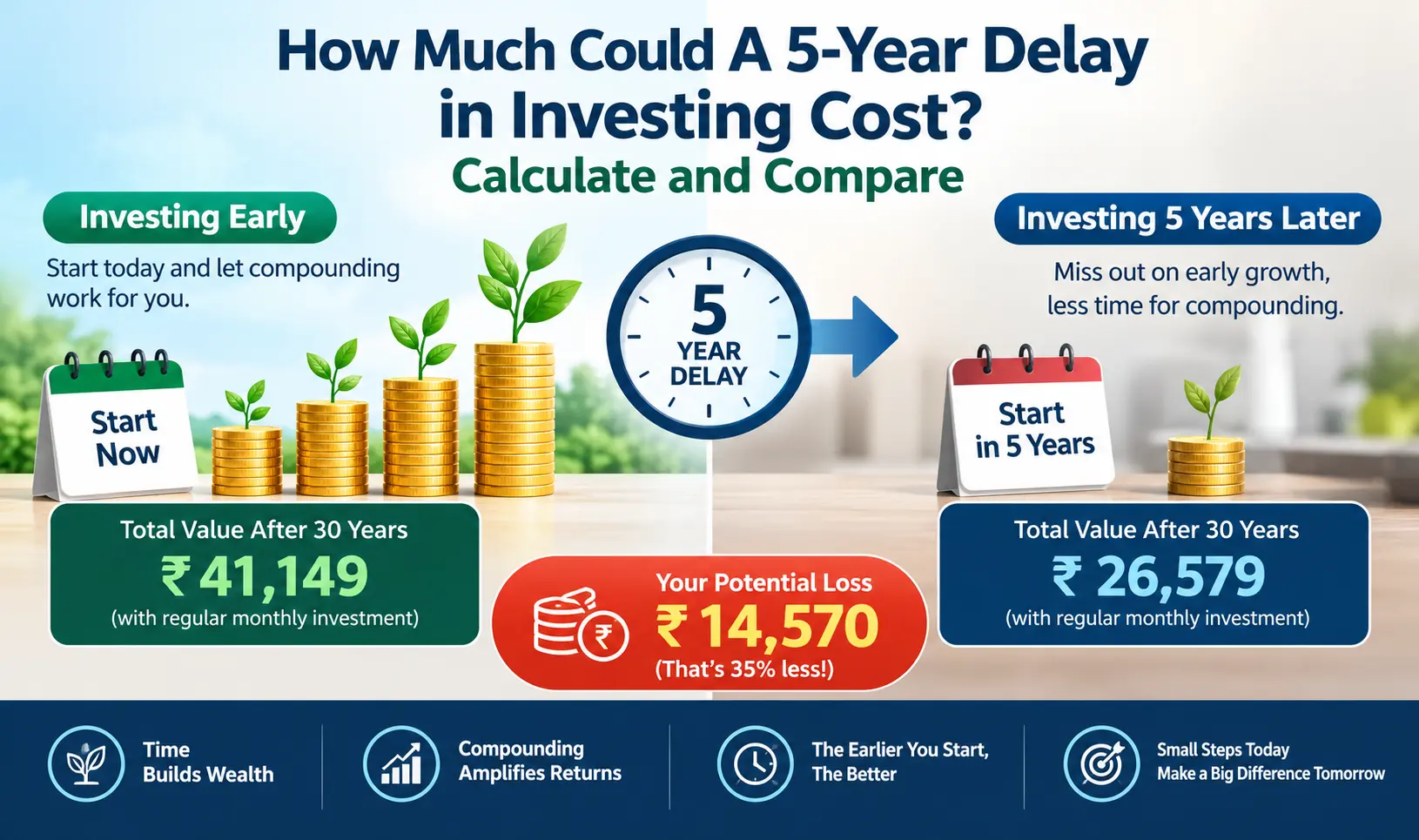
It is easy to believe that waiting a few years before investing will not make much difference. After all, five years may not feel like a long time in the context of a 25- or 30-year financial journey. However, when you bring compounding into the picture, even a relatively short delay may have a noticeable impact on the potential value of your investments. Let us look at how a 5-year delay could affect long-term outcomes with the help of a compound interest calculator.
Why Time Matters More Than You Think
When you invest, your potential returns may begin to generate further returns over time. This process is known as compounding. The longer your money remains invested, the longer it may benefit this effect.
A delay does not just mean losing five years of contributions. It also means losing five years during which those contributions could have potentially grown. If you compare two timelines in a compound interest calculator one starting today and another starting five years later – you can visualise the gap for yourself. To understand this better, let us compare two scenarios. All numbers are for illustrative purposes only.
Scenario 1: Start today vs start after 5 years
- Monthly investment: ₹200
- Investment period: 25 years
- Assumed annual return: 10% (compounded monthly)
Investor A: Starts immediately
- Invests ₹200 per month for 25 years
- Total invested: ₹60,000
Illustrative future value after 25 years: approximately ₹265,000
Investor B: Delays by 5 years
- Invests ₹200 per month for 20 years
- Total invested: ₹48,000
Illustrative future value after 20 years: approximately ₹152,000
What is the Difference?
When seen through a table, the difference becomes even more apparent.
|
Detail |
Investor A |
Investor B |
|
Years Invested |
25 |
20 |
|
Total Invested |
₹60,000 |
₹48,000 |
|
Final Value |
₹265,000 |
₹152,000 |
|
Difference in potential value: ₹113,000 |
||
By delaying five years, Investor B invested ₹12,000 less. However, the difference in potential corpus is far larger than ₹12,000 because of the compounding effect over time. This highlights that the “cost of delay” is not limited to missed contributions. It includes the potential growth on those contributions as well.
Also Read: Top 10 Investment Banking Companies in India
A Second Comparison: Same End Age, Different Start Ages
Let us take a longer-term example.
Assumption:
- Monthly investment: ₹300
- Assumed return: 10% annually
- Retirement age: 60
Investor C: Starts at age 30
- Invests for 30 years
- Total invested: ₹108,000
- Illustrative value at 60: approximately ₹678,000
- Investor D: Starts at age 35
- Invests for 25 years
- Total invested: ₹90,000
- Illustrative value at 60: approximately ₹400,000
Impact of the 5-Year delay
|
Detail |
Investor C |
Investor D |
|
Years invested |
30 |
25 |
|
Total invested |
₹108,000 |
₹90,000 |
|
Final value |
₹678,000 |
₹400,000 |
|
Difference in potential value: ₹278,000 |
||
- Here, the later investor contributed ₹18,000 less, yet the potential difference in accumulated value is significantly larger.
- This is the mathematical impact of lost compounding years.
Examples are for illustrative purpose only
Why the Gap Becomes so Large
Compounding does not happen in a straight line. It accelerates over time. In the early years, growth may appear modest. However, in later years, the accumulated amount may start generating higher potential gains simply because the base amount is larger.
When you delay Investing:
- You reduce the total contribution period
- You reduce the compounding duration
- You shorten the time available for recovery from market fluctuations
How to Calculate Your own Cost of Delay
If you want to understand how a delay could affect your specific numbers, you can use a compound interest calculator to estimate potential outcomes under different timelines.
Try comparing:
- Investing for 30 years vs 25 years
- Increasing monthly contribution instead of delaying
- Adjusting assumed return rates cautiously
Remember, calculators provide estimates based on assumptions. Actual returns from market-linked investments may vary and are not guaranteed. The calculator is an aid, not a prediction tool. It may provide only an indicative picture.
Is it Ever too late to Start?
Starting earlier may increase the likelihood of building a larger corpus over time. However, if you have already delayed, the focus can shift to:
- Extending your investment horizon where possible
- Reviewing your asset allocation carefully
- Increasing contributions gradually if suitable
- Maintaining discipline during market volatility
While past time cannot be recovered, future time can still be used effectively.
The Real Cost of Waiting
A five-year delay may not feel significant emotionally. Financially, however, the numbers can tell a different story. In both examples above, the difference was not simply the amount not invested during those five years. The larger impact came from the loss of potential compounding over a longer horizon.
The takeaway is not urgency or pressure. It is awareness. Time is one of the few factors in investing that cannot be regained. Even modest, regular contributions started earlier may potentially accumulate more over the long term than larger contributions started later.
Mutual Fund Investments are Subject to Market Risks, Read all Scheme Related Documents Carefully.
This document should not be treated as endorsement of the views/opinions or as investment advice. This document should not be construed as a research report or a recommendation to buy or sell any security. This document is for information purpose only and should not be construed as a promise on minimum returns or safeguard of capital. This document alone is not sufficient and should not be used for the development or implementation of an investment strategy. The recipient should note and understand that the information provided above may not contain all the material aspects relevant for making an investment decision. Investors are advised to consult their own investment advisor before making any investment decision in light of their risk appetite, investment goals and horizon. This information is subject to change without any prior notice.